If you come from consumer electronics, smart hardware, or a more conventional electronics engineering background, your first encounter with toy electronics in Chenghai can be surprising.
This article explains how Chenghai toy electronics balance cost, function, and manufacturability.
You may see paper-based circuit boards, extremely low-cost voice ICs, through-hole components, and audio capacity quoted simply as “how many seconds at 6K.”
From a purely technical perspective, some of these technologies may look old-fashioned.
But describing Chenghai toy electronics as simply “outdated” misses the more interesting point.
Over many years, the local toy industry has developed a highly mature low-cost electronics ecosystem built around one core question:
What is the lowest-cost way to make this function work reliably?
That is a very different mindset from asking:
What is the most advanced technology we can use?
At ToyRD, we believe the best way to understand toy electronics is not to start with advanced MCUs, Bluetooth SoCs, or AI chips.
It is better to start with the most basic thing inside many electronic toys:
a circuit board.
Before We Start: What Is the Relationship Between Shantou and Chenghai?
For overseas buyers and product developers, this is worth understanding first.
Shantou is a prefecture-level city in Guangdong Province, and Chenghai is a district under Shantou.
In simple terms:
Shantou is the larger set. Chenghai is a subset of Shantou.
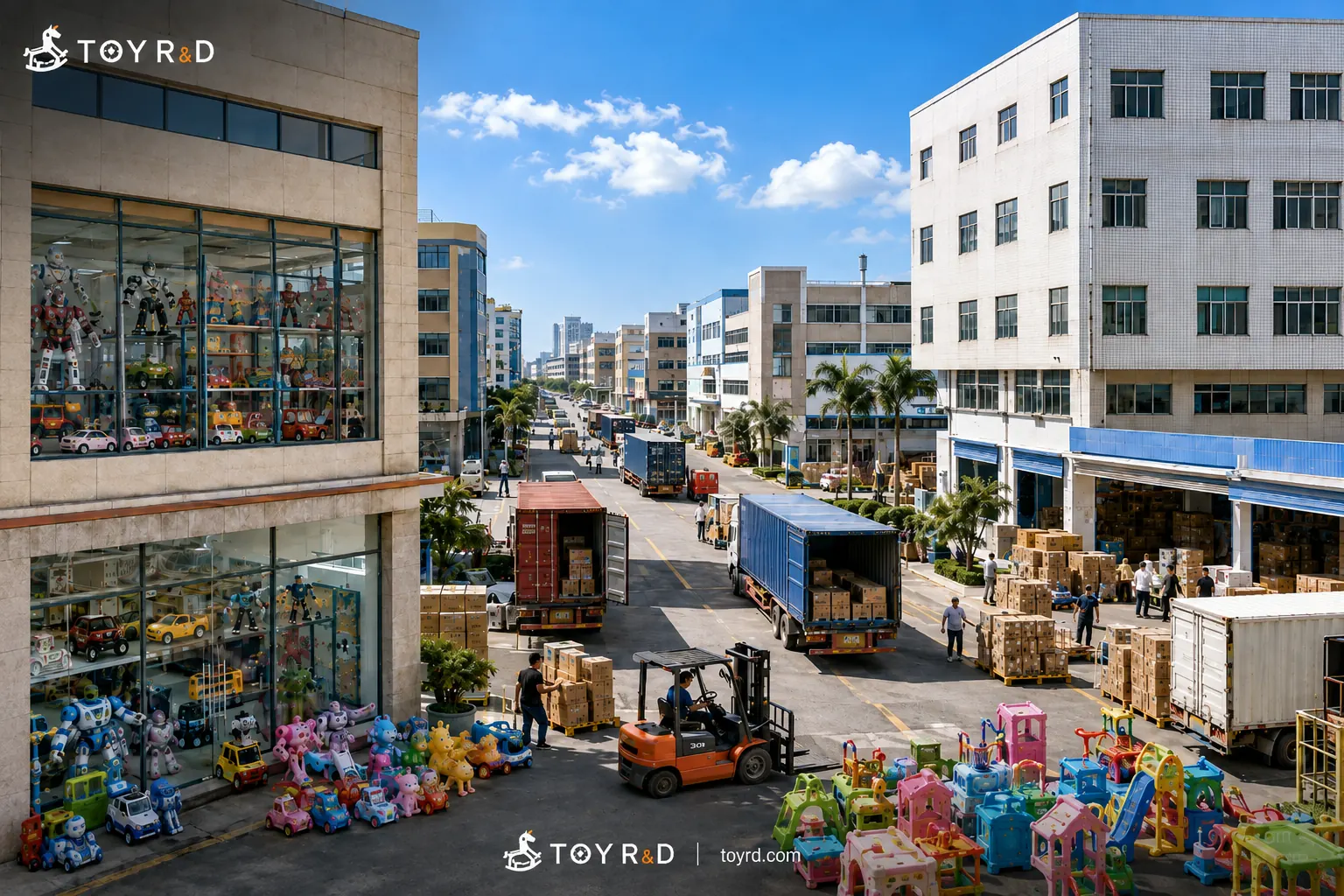
So when someone says they are going to “Shantou” to develop toys, they may actually spend much of their time in Chenghai District, because Chenghai is the core toy manufacturing and development cluster within Shantou.
This distinction can be confusing to international buyers because both names are commonly used in the industry.
You may hear:
- Shantou toy factories
- Shantou toy suppliers
- Chenghai toy factories
- Chenghai toy market
- Chenghai electronics suppliers
In many practical business conversations, these descriptions overlap because Chenghai is part of Shantou and is deeply associated with the city’s toy industry.
For clarity, ToyRD uses the terms this way:
- Shantou refers to the broader city and regional supply-chain environment.
- Chenghai refers more specifically to the main toy manufacturing, development, component, and supplier cluster.
If you are an overseas buyer coming to develop toys here, understanding this relationship makes supplier searches, factory visits, transportation planning, and communication much easier.
1. Toy Electronics Often Begin with a Very Cheap PCB
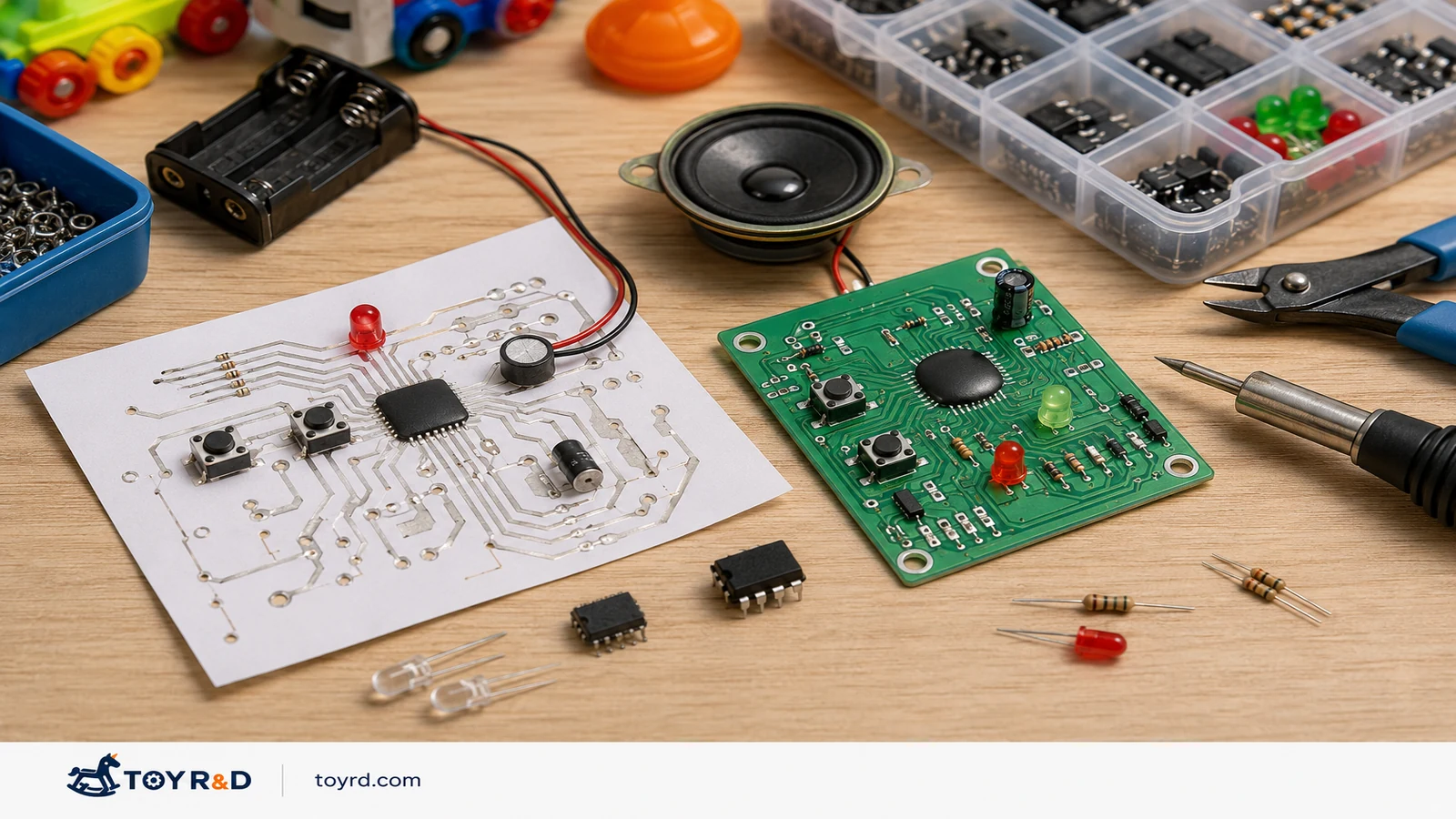
Many engineers associate PCBs with standard green FR-4 fiberglass boards.
In low-cost toys, however, that is not always the case.
A large number of simple light-and-sound toys in Chenghai still use paper-based copper-clad boards.
Compared with higher-grade PCB materials, paper-based boards have clear limitations in mechanical strength, heat resistance, dimensional stability, and circuit complexity.
But the real question is:
Does a simple toy with a few LEDs, several buttons, one voice IC, and a speaker actually need a higher-grade PCB?
In many cases, it does not.
If the circuit is simple, power consumption is low, operating temperatures are normal, and there is no special requirement for dense routing or mechanical strength, a paper-based PCB can already be good enough.
And its biggest advantage is simple:
It is cheap.
When the total factory cost of a toy is only a few RMB or a little over ten RMB, saving even a few tenths of a yuan on the PCB matters.
At production volumes of 100,000, 500,000, or even one million units, very small differences become very large numbers.
This creates a clear cost hierarchy in the Chenghai toy electronics supply chain.
At the low end, paper-based boards are still common.
At the next level, suppliers may use thinner or better-performing board materials.
Higher-end products, products with more complicated circuits, or products with stricter reliability requirements are more likely to use resin- and fiberglass-based PCB materials.
The important principle is:
A PCB should not be selected because it is “better.” It should be selected because it is appropriate for the product.
That sounds obvious.
The difficult part is knowing where “good enough” ends.
2. Why Toy IC Suppliers Often Ask: “How Many Seconds Do You Need?”
One of the most distinctive features of traditional toy electronics in Chenghai is the way voice ICs are discussed.
If you are developing a consumer electronics product, a chip discussion may involve Flash size, RAM, CPU architecture, codecs, DAC performance, sampling rate, bit depth, or processing capability.
In many traditional toy electronics businesses, the conversation can be much simpler.
You ask:
How much is this IC?
The supplier may ask:
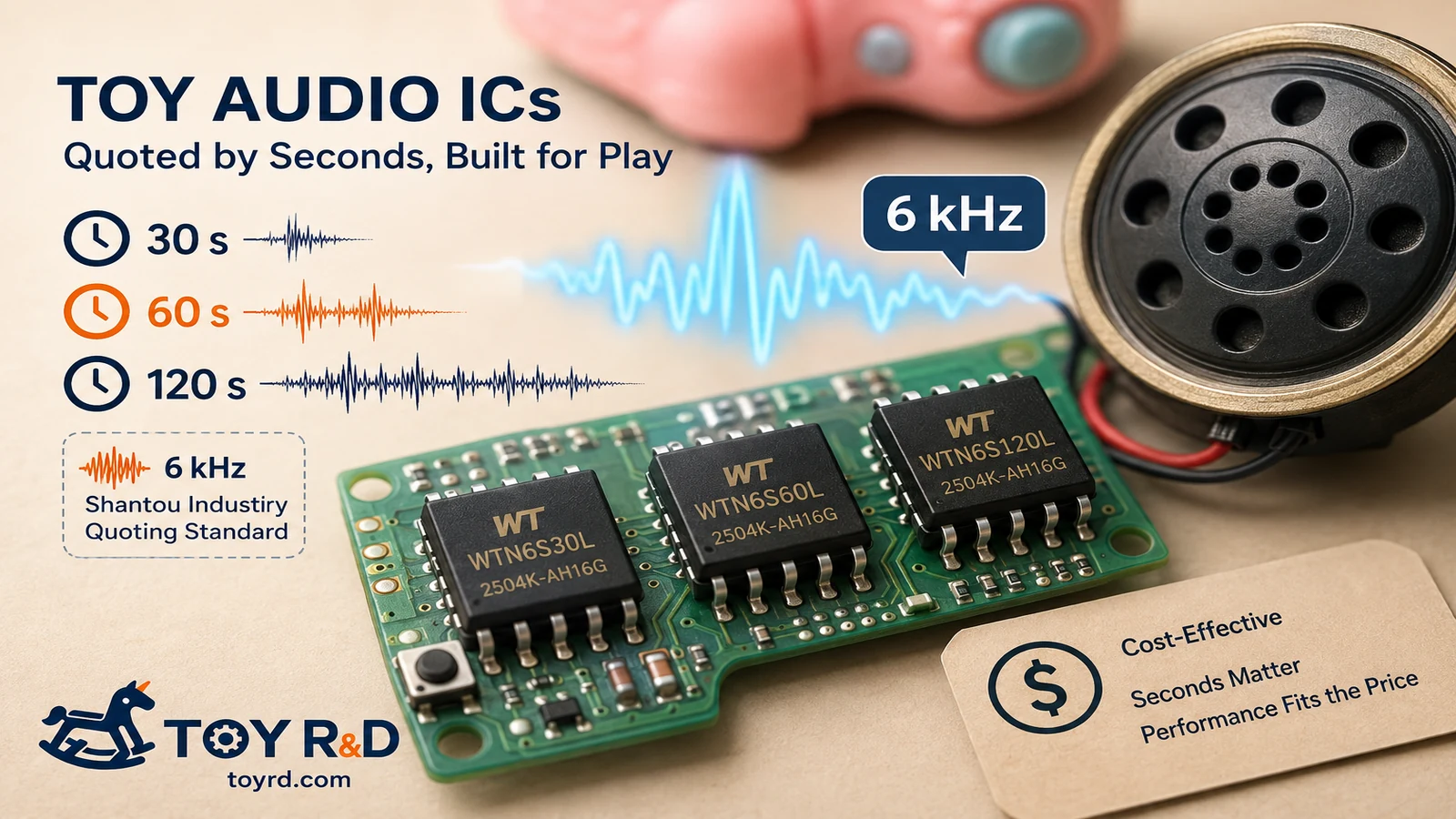
“How many seconds of audio do you need?”
Thirty seconds.
Sixty seconds.
One hundred and twenty seconds.
One hundred and eighty seconds.
For a large number of low-cost sound toys, audio duration itself becomes one of the most practical ways to define an IC option and quote a price.
And in the local toy electronics market, one very classic phrase is:
“Calculate it at 6K.”
Here, “6K” typically refers to using roughly a 6 kHz sampling rate as a practical reference point for estimating how much audio a voice IC can store.
So a supplier may tell you:
This IC can hold this many seconds at 6K.
Another IC can hold more.
Then the designer chooses the IC according to the total audio duration required.
For an electronics engineer, this is obviously not a complete technical description of the chip.
But for the toy industry, it is extremely efficient.
The real commercial questions are often only:
- Will the audio fit?
- Is the sound quality acceptable?
- How much does it cost?
That is why “6K plus audio duration” has become a very recognizable shorthand in traditional toy electronics.
3. “60 Seconds at 6K” Does Not Mean Two ICs Are the Same
There is an important limitation to this way of quoting.
Suppose two IC suppliers both say:
Our chip can store 60 seconds of audio at 6K.
That does not mean the two chips use the same storage capacity, the same encoding method, or produce the same sound quality.
Different IC suppliers may use different audio coding and compression methods.
They may differ in:
- compression ratio;
- bit depth;
- decoding algorithm;
- DAC performance;
- noise level;
- optimization for speech versus music.
One IC may sound acceptable for spoken phrases but poor for music.
Another may sound noticeably cleaner even if both are quoted using the same nominal audio duration.
So “6K, 60 seconds” should be understood as:
a fast quotation language used by the toy supply chain, not a complete technical specification.
This kind of shorthand is common in mature industries.
It compresses a lot of practical background knowledge into a few words.
4. Why Cheap Toys Often Sound Like “Toy Audio”
This also helps explain a familiar phenomenon.
Why can you often recognize the sound of a low-cost toy almost immediately?
Part of the answer is the audio data itself.
A higher sampling rate generally means more audio data.
More data requires more storage.
More storage often means a more expensive IC.
For a low-cost toy, the engineering question therefore becomes:
Is better audio quality worth increasing the IC cost by several tenths of a yuan?
Very often, the answer is no.
The product may only need to achieve four things:
- the child can understand the words;
- the song is recognizable;
- the sound is loud enough;
- there is no unacceptable noise or distortion.
It usually does not need:
- high-frequency detail;
- wide dynamic range;
- high-fidelity playback;
- audio performance comparable to consumer speakers.
This is one of the clearest differences between toy electronics and consumer audio electronics.
5. Sound Quality Depends on Much More Than the IC
It would also be wrong to blame poor toy audio entirely on a low sampling rate.
In a real product, sound quality is the result of an entire signal chain.
It can depend on:
- the original audio file;
- encoding and compression;
- the voice IC;
- DAC or output stage;
- amplifier;
- speaker;
- acoustic cavity;
- product enclosure;
- sound holes;
- even plush fabric, silicone skins, or internal structural parts.
This is why simply replacing an IC with a “better” one does not always produce a dramatic improvement.
Sometimes the real bottleneck is a very inexpensive speaker.
Sometimes it is the acoustic cavity.
Sometimes it is the enclosure.
At ToyRD, we therefore prefer to look at toy audio as a complete system rather than focusing on a single specification such as sampling rate.
6. Why a Few Cents of Through-Hole Labor Still Matter
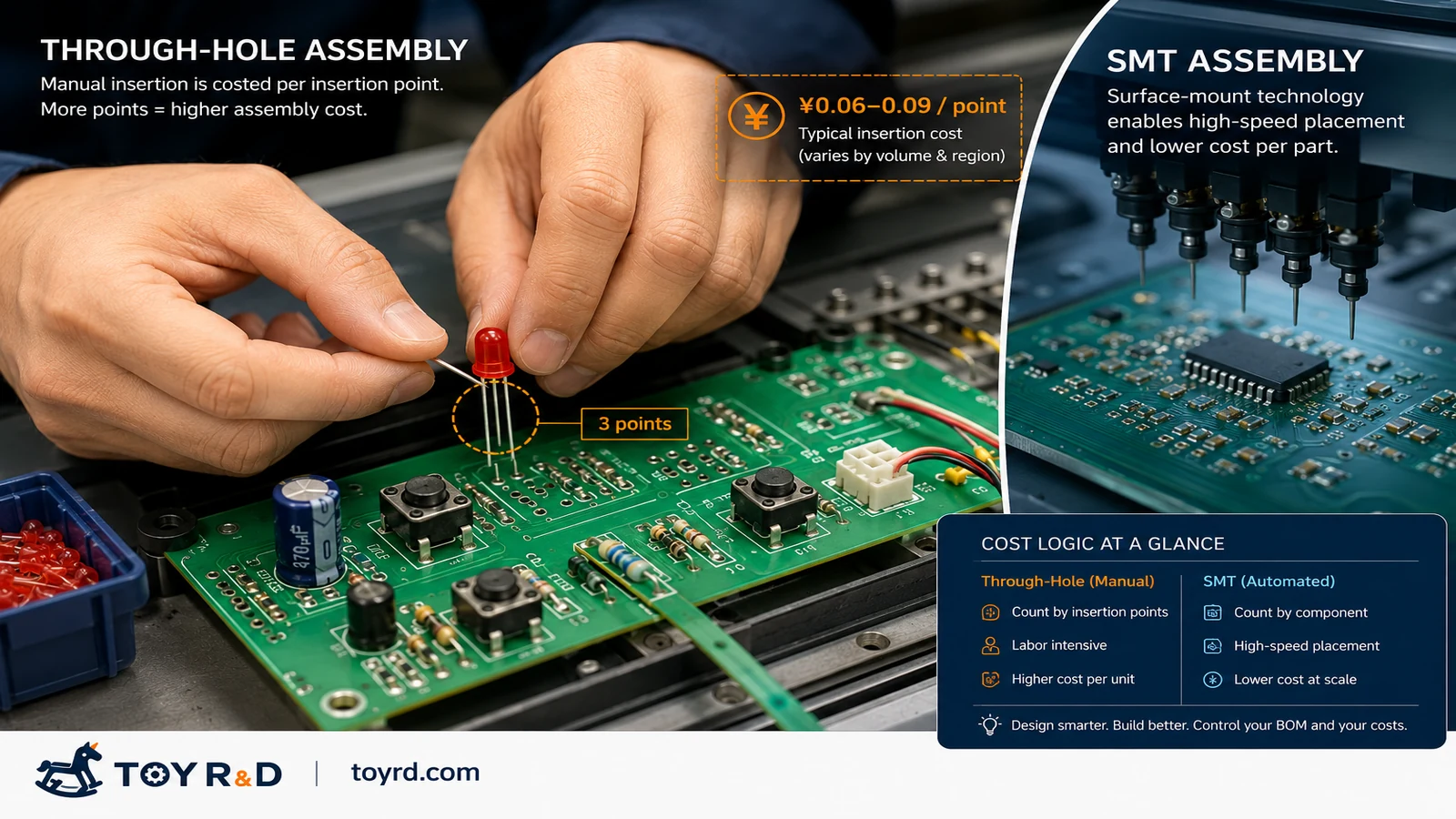
Another very characteristic part of low-cost toy electronics is through-hole assembly.
Many low-cost toy PCBs still contain through-hole components such as:
- electrolytic capacitors;
- switches;
- connectors;
- wires;
- LEDs;
- other manually inserted parts.
In the local electronics supply chain, through-hole assembly labor is often calculated per insertion or soldering point, not simply per component.
A practical market reference we have encountered is approximately:
RMB 0.06–0.09 per point.
This distinction is important.
For example, if an LED has three leads, it is counted as three points.
At RMB 0.06 per point:
3 × 0.06 = RMB 0.18
At RMB 0.09 per point:
3 × 0.09 = RMB 0.27
So a single three-lead LED may represent RMB 0.18–0.27 of through-hole labor.
That may still sound insignificant.
But now imagine a PCB design adds several extra through-hole points.
Suppose a design adds 5 extra points, with labor priced at RMB 0.08 per point:
5 × 0.08 = RMB 0.40 per product
At 100,000 units, that becomes:
RMB 40,000
This is one of the most important ways to understand toy cost engineering.
An engineer may look at a component and think:
“It is only one small part.”
The factory sees:
“This action has to be repeated 100,000 times.”
That is why toy electronics engineers may redesign a PCB simply to remove several insertion points, eliminate a connector, reduce manual soldering, or combine functions.
7. SMT Has a Different Cost Structure
Surface-mount assembly follows a different economic model.
SMT is more automated and can be highly efficient for stable, high-volume production.
But it should not be simplified into:
SMT is always cheaper than through-hole assembly.
SMT costs can also involve:
- stencil preparation;
- placement points;
- component count;
- PCB panelization;
- machine setup;
- production-line changeover;
- order quantity;
- component packaging;
- reflow and inspection.
For small production runs, fixed setup costs may make the cost per PCB relatively high.
For orders of tens or hundreds of thousands of units, the economics can be completely different.
So there is no universal rule that every component should be converted to SMT.
The correct answer depends on:
- production volume;
- component type;
- PCB layout;
- automation level;
- total manufacturing cost.
This is why the real value of an experienced electronics solution provider is not just the ability to draw a PCB.
It is knowing:
how to design the PCB so that it is economical to manufacture.
That cost-and-reliability trade-off is the lens ToyRD uses when turning an electronics concept into a production-ready toy.
8. Why Does Chenghai Still Use So Many “Old” Technologies?
At this point, it is tempting to conclude:
Is Chenghai electronics simply technologically behind?
That is only half true.
From a technology-generation perspective, many low-cost toy electronics solutions are indeed based on mature and sometimes very old technologies.
But from an industrial perspective, Chenghai has become extremely good at extracting value from those technologies.
A very inexpensive IC.
A very cheap PCB.
A low-cost speaker.
A few buttons.
A few LEDs.
Together, they may deliver:
- power-on sound;
- music;
- lighting;
- button interaction;
- automatic shutdown.
And the entire electronics solution may cost remarkably little.
For a toy retailing for only a few dollars, that may be exactly the right engineering solution.
If the design were upgraded purely for the sake of “modern technology” to include a higher-spec MCU, larger Flash, higher-grade PCB, and more sophisticated power management, the user experience might improve, but the electronics cost could rise significantly.
That would not automatically make it a better product.
9. Several Generations of Toy Electronics Now Coexist in Chenghai
Modern Chenghai toy electronics can no longer be described only in terms of cheap voice ICs.
The market is now clearly segmented.
At the most traditional level, you may still see:
- paper-based PCBs;
- low-cost voice ICs;
- LEDs;
- through-hole parts;
- simple buttons;
- basic speakers.
A step above that, products may use:
- better PCBs;
- more SMT;
- improved audio solutions;
- MCUs;
- sensors;
- lithium batteries;
- USB-C;
- more advanced power management.
And at the higher end, the architecture becomes completely different:
- Bluetooth;
- mobile apps;
- MEMS microphones;
- sound detection;
- external Flash;
- OTA updates;
- Wi-Fi;
- cloud services;
- even AI.
This creates an interesting reality:
A very cheap traditional toy voice IC and a Bluetooth SoC connected to a mobile app may both be widely used in the same Chenghai electronics market.
There is no contradiction.
They serve completely different products.
10. Good Toy Electronics Are Not About Using the Most Advanced Technology
This is one of the most important lessons in toy development.
We should understand advanced technology.
But the purpose of engineering is not to prove how many advanced technologies we can put into a product.
The real question is:
What does this product actually need?
If a paper-based PCB is sufficient for a simple light-and-sound toy, then it can be the correct choice.
If 6 kHz audio is good enough for the intended product, there may be no reason to increase system cost simply to make the specification look better.
But the opposite is also true.
If the product is positioned at the mid- or high-end, and consumers care about sound quality, connectivity, battery life, reliability, and interaction, then continuing to use the lowest-cost architecture may become the wrong decision.
The real difficulty in toy electronics is therefore not learning one particular IC.
It is learning to judge:
when to save cost, and when not to save cost.
That is one of the reasons ToyRD is gradually documenting these fundamentals.
A great deal of toy engineering knowledge is not mysterious.
It is simply scattered across electronics markets, supplier quotations, factory experience, and years of mass-production projects.
Paper-based PCBs, 6 kHz audio, and a few cents of labor per insertion point may sound like small details.
But when enough of these details are connected together, you begin to understand something much bigger:
how a toy can be manufactured at the price it is.
And that may be one of the most valuable things to understand about Chenghai toy electronics and the broader Shantou toy supply chain.