
In toy development, the most expensive compliance problem is not always a failed test.
Sometimes the bigger problem starts earlier: a new regulation is interpreted in a certain way, the product is redesigned around that interpretation, and the redesign then triggers a different set of safety requirements.
What looks like a conflict between two regulations may actually be a chain reaction caused by an earlier design decision.
We recently came across a good example involving a rechargeable electronic toy. The case is useful because it shows why compliance should not be treated as something that happens only after a sample arrives at the laboratory.
At ToyRD, this is exactly the kind of problem we like to examine from the development side: not only *what does the standard say?*, but also *what product definition did we create before the standard was applied?*
The Original Product Was Never Designed for Consumer Battery Replacement
The product was a rechargeable electronic toy with sound and light functions.
Internally, it contained the usual components: a PCB, a rechargeable lithium-polymer battery, a speaker, LEDs, and a charging circuit.
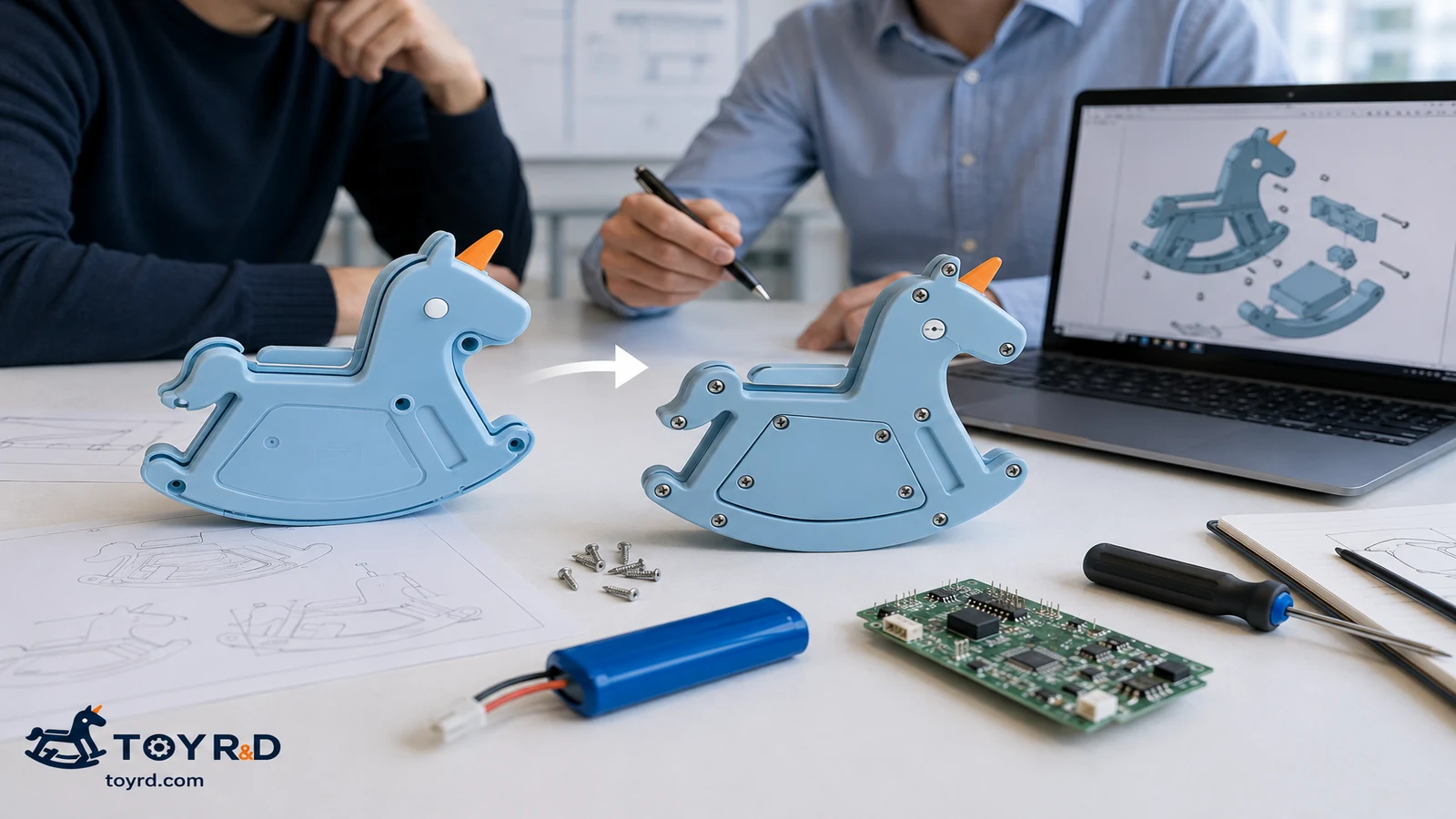
The original enclosure was simple. The upper and lower plastic housings were joined by ultrasonic welding.
From a product-use perspective, there was no reason for the consumer to open the housing. The user could charge and operate the toy normally, while the battery remained inside the product.
In other words, the original design logic was:
Rechargeable product, sealed enclosure, no user battery replacement.
Then the EU Batteries Regulation entered the discussion.
"The Battery Must Be Replaceable" Became "The Consumer Must Replace It"
Regulation (EU) 2023/1542 introduced new requirements for the removability and replaceability of portable batteries.
Article 11 establishes a general rule that portable batteries incorporated into products should be readily removable and replaceable by the end-user during the lifetime of the product. It also explains that commercially available tools may be used; "removable" does not necessarily mean tool-free.
The requirement under Article 11 applies from 18 February 2027.
When the customer first heard about this requirement, the interpretation was understandable:
The battery can no longer be permanently sealed inside the product.
But the next assumption was more consequential:
Therefore, the consumer must be able to open the toy and replace the battery personally.
That assumption immediately became a mechanical-design decision.
The original ultrasonic-welded enclosure was changed to a screw-closed enclosure.
On the surface, this looked like a straightforward compliance improvement:
Ultrasonic welding = cannot open. Screws = can open.
But something more important than the fastening method had changed.
The product's serviceability definition had changed.
It was no longer merely a rechargeable product with an internal battery. It was moving toward being defined as a product whose internal battery was intentionally accessible for replacement by the user.
That distinction matters.
One Sentence in the Instructions Changed the Compliance Path Again
Later, the customer prepared the user instructions and included wording stating that the consumer could open the product and replace the internal battery.
That sentence reinforced the new product definition.
From a compliance perspective, the laboratory was no longer looking only at a rechargeable toy with an internal battery. The documentation now explicitly described a product that the user was expected to open in order to access and replace that battery.
That naturally raised another set of questions.
If the user is expected to open this part of the toy:
- How is access controlled?
- Can a child gain access to the battery?
- What happens to the screws after the cover is opened?
- Are the fasteners part of the battery-safety system?
- Does the battery compartment construction meet the applicable toy electrical-safety requirements?
This is where EN IEC 62115 entered the picture.
The laboratory was not contradicting the EU Batteries Regulation. It was evaluating the product that had now been presented to it: a toy with an intentionally openable battery-access structure.
Then the 20 N for 10 Seconds Requirement Appeared
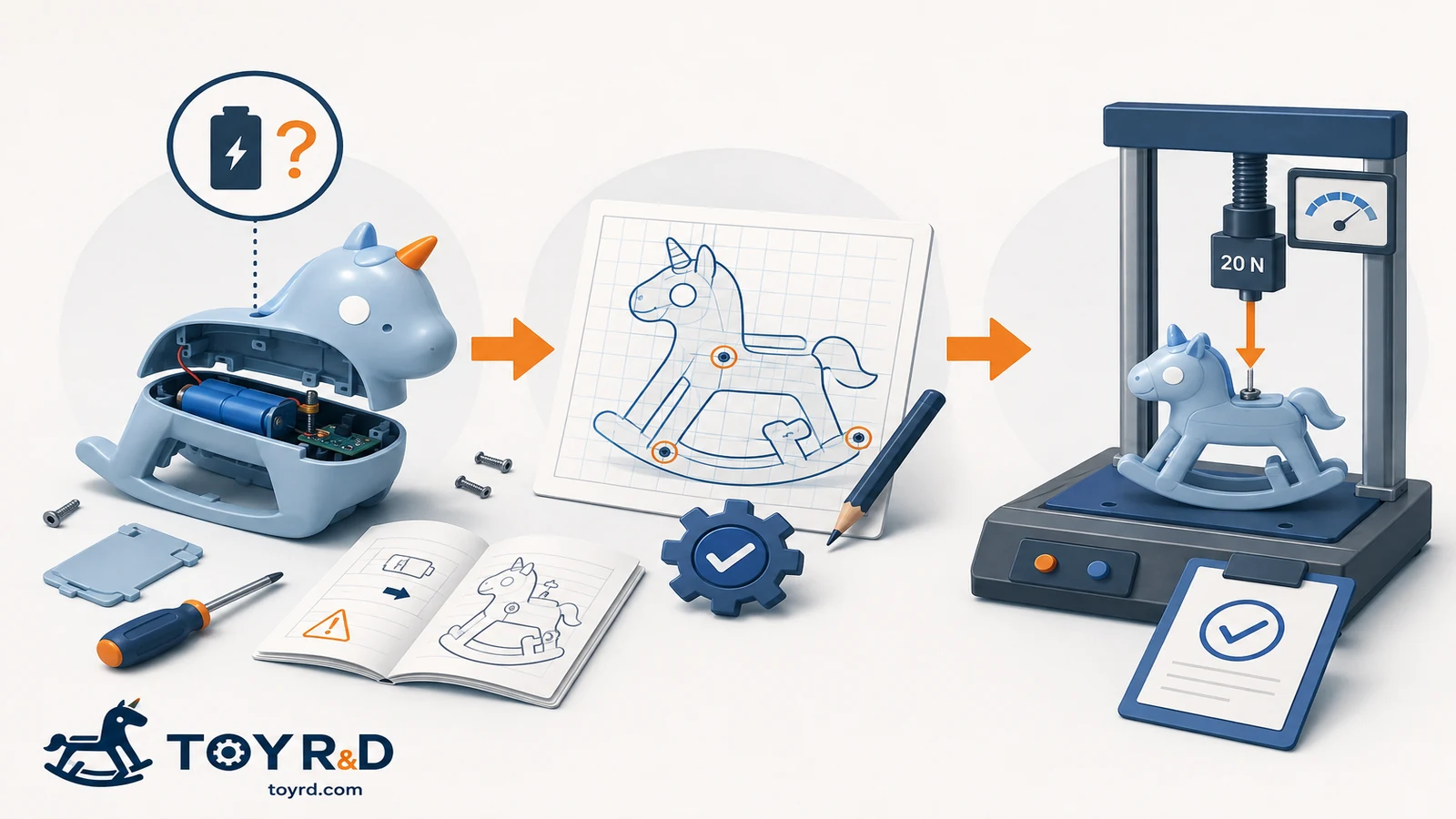
EN IEC 62115:2020+A11:2020 includes requirements for fasteners used to secure doors or covers that provide access to a battery compartment.
Clause 13.4.6 addresses captive battery-compartment fasteners. Where the clause applies, the screw or similar fastener is expected to remain with the door, cover, or equipment after opening.
The associated test applies a force of 20 N for 10 seconds to the fastener.
An important engineering detail is that this is 20 N of force, not a torque value.
From the laboratory's perspective, this requirement makes sense. If a screw is part of the system that prevents inappropriate access to a battery, losing that screw after opening the compartment could undermine the safety function during later use.
But from the project team's perspective, the situation suddenly looked contradictory:
The EU wants the battery to be replaceable.
while at the same time:
The toy-safety standard places additional restrictions on the construction used to access the battery.
The natural reaction is to ask:
Which rule are we supposed to follow?
The better question is:
Did the first rule actually require us to define the product this way?
Go Back Upstream: What Does the EU Batteries Regulation Actually Require?
Article 11 of Regulation (EU) 2023/1542 does establish a strong general principle of battery removability and replaceability.
For many products, the intention is clear: a battery should not unnecessarily turn an otherwise usable product into waste simply because the battery has reached the end of its useful life.
But the regulation also recognizes that end-user replacement is not always compatible with product safety.
Article 11 includes derogation mechanisms under which certain products may be designed so that the battery is removable and replaceable only by independent professionals.
That distinction is critical.
"The battery must be replaceable" does not always mean "the ordinary consumer must personally open the product and replace it."
For a child-related product, that difference can completely change the engineering solution.
A product may need to be serviceable without being designed as a consumer-openable battery compartment.
July 2026 Made the Toy Case Much More Relevant
On 14 July 2026, the European Commission adopted Commission Delegated Regulation C(2026) 5031 final, supplementing the Batteries Regulation with additional derogations from the end-user removability and replaceability requirement.
One of the specifically listed categories is:
electric toys that incorporate rechargeable batteries
The proposed derogation applies until 31 July 2030 where, due to the nature or size of the toy, the derogation is necessary to ensure the safety of the toy.
Under that route, the rechargeable battery may be removable and replaceable only by independent professionals, rather than by the end-user.
This is an important development for rechargeable toy design.
It reflects a basic safety reality: the policy goal of making batteries replaceable should not force a toy manufacturer to introduce a new child-access hazard simply to make the battery easier for a consumer to reach.
There is, however, an important status note.
At the time of writing, 30 August 2026, C(2026) 5031 has been adopted by the European Commission but is still within the European Parliament and Council scrutiny process. EUR-Lex lists 14 October 2026 as the foreseen end of the objection period. The act enters into force only after the required procedure and publication in the Official Journal are completed.
So it should not yet be described as a fully effective exemption without that qualification.
The 2030 Toy Safety Rules Show the Same Direction
The regulatory direction becomes even clearer when we look at Regulation (EU) 2025/2509, the new EU Toy Safety Regulation, which will replace the current Toy Safety Directive from 1 August 2030.
Its electrical-safety provisions state that batteries constituting small parts must not be accessible without a tool. It also provides that, where the size or nature of the toy requires it, a rechargeable battery may instead be made inaccessible and removable or replaceable only by independent professionals.
This helps explain why the 2026 delegated act provides a temporary toy-related derogation through 31 July 2030.
The policy direction is not:
Make every rechargeable toy easy for a consumer to open.
It is closer to:
Make battery replacement possible, while preserving the safety level required for the toy.
Those are very different design objectives.
Now the Original Project Becomes Much Easier to Understand
If we map the project as a development chain, the problem is clearer:
EU Batteries Regulation introduces battery removability and replaceability requirements
↓
interpreted as
The consumer must personally replace the internal battery
↓
therefore
Ultrasonic welding is replaced by screws
↓
the instructions state
The consumer can open the product and replace the battery
↓
the product is now presented as
User-openable with accessible battery replacement
↓
the laboratory evaluates the resulting structure under the relevant battery-access requirements of EN IEC 62115
↓
additional requirements appear, including
battery-compartment fastener / captive-screw requirements
The key point is this:
The Batteries Regulation did not directly create the EN IEC 62115 fastener problem.
The intermediate product-definition decision did.
That is why describing the situation simply as "two regulations are conflicting" misses the most useful lesson.
Do Not Start by Asking How to Make the Screw Pass
Once a laboratory raises the 20 N / 10 s requirement, the immediate engineering reaction is often:
How do we redesign the screw?
Maybe use a captive screw. Maybe change the thread. Maybe modify the housing. Maybe change the cover.
Those may eventually be necessary.
But at ToyRD, we would first move one step upstream and ask:
Does this product actually need to be defined as consumer battery-replaceable?
That question should be answered before committing to another structural redesign.
If the applicable regulatory route allows this particular rechargeable toy to use independent-professional battery replacement, then the product design, risk assessment, instructions, and laboratory test definition should all follow that same logic.
The instructions should not simultaneously tell an ordinary consumer to open the toy and replace the battery themselves.
On the other hand, if the commercial decision is genuinely to provide consumer battery replacement, then the product should be engineered from the beginning as a proper user-serviceable battery system, with all the corresponding toy-safety requirements considered.
Simply changing ultrasonic welding into several ordinary screws is not the same as designing a compliant consumer-accessible battery compartment.
Deleting One Sentence from the Manual Is Not the Whole Solution
In this case, removing the statement that the consumer can replace the battery may be part of the correction.
But changing the manual alone is not enough.
The project needs four things to agree with each other:
Regulatory path → Product design → User instructions → Laboratory test definition
If the intended route is professional battery replacement, the product and instructions should consistently reflect that.
If the intended route is end-user replacement, the enclosure and battery-access system should be designed accordingly.
A compliance document should describe the product that actually exists.
It should not be used to create a different product definition after the engineering work has already been completed.
This Is Why ToyRD Focuses on Design-Stage Compliance
Compliance is often treated as the last step of product development:
Design → Tooling → Sample → Laboratory → Pass or fail
That approach works until a test failure reveals that the problem started much earlier.
By the time the laboratory identifies the issue:
- the enclosure may already be tooled;
- the PCB may already be frozen;
- production samples may exist;
- manuals may be written;
- packaging may be in artwork;
- schedules may already be committed.
At that stage, a misunderstanding that originally cost nothing to correct can become an expensive engineering change.
At ToyRD, we prefer a different question:
Before changing the product, are we sure we are solving the requirement that actually applies?
This is part of what we mean by a development-stage Second Opinion.
Sometimes the most valuable compliance input is not another test.
It is stopping a design change long enough to verify why that change is being made.
Four Questions Before Changing a Toy Because "The EU Requires It"
Whenever a new regulatory requirement reaches the engineering team, these four questions are worth asking before modifying the product.
1. What regulation or standard are we actually talking about?
"The EU requires it" is not a specification.
Find the regulation, article, standard, clause, or official guidance behind the request.
2. What does the original requirement actually say?
A regulatory objective and an engineering solution are not the same thing.
"The battery must be replaceable" is a regulatory requirement.
"Therefore the consumer must remove four screws and replace it personally" is an engineering interpretation.
There may be other compliant routes.
3. Does this exact requirement apply to this exact product?
Battery type, toy category, age grading, safety risks, product construction, intended use, and placing-on-the-market date can all affect the answer.
Compliance should always return to the actual product.
4. Will this design change trigger another requirement?
This is where engineering and compliance have to meet.
Changing one fastening method may change:
- battery accessibility;
- child access;
- small-parts risks;
- fastener requirements;
- servicing method;
- instructions;
- risk assessment;
- laboratory test conditions.
A product is evaluated as a system, not one regulation at a time.
Regulatory Misinterpretation Has a Real Development Cost
There is a type of product-development cost that rarely appears in a BOM:
Regulatory Misinterpretation Cost.
A tooling modification costs money.
Another prototype round costs money.
Another laboratory submission costs money.
Updating the manual and packaging costs money.
A delayed launch costs money.
But sometimes all of those costs begin with a sentence like:
"We heard the EU will require this."
The purpose of good compliance work is therefore not only to tell a team which clause to test.
It is also to help the development team determine what that clause means before it becomes plastic, tooling, documentation, and production inventory.
For ToyRD, that is an important part of R&D intelligence:
Understand the regulation. Define the product correctly. Then design the solution.
Sometimes a useful Second Opinion does not add another feature or another test.
Sometimes it simply asks, before the mold is changed:
Are we solving the right problem?
Disclaimer: This article discusses product-development and regulatory reasoning and is not legal advice. Applicability depends on the specific product, battery, intended use, age grading, market-entry date, final legislation in force, and assessment by competent compliance professionals or laboratories.
References
1. Regulation (EU) 2023/1542 on batteries and waste batteries — Article 11, removability and replaceability of portable batteries. https://eur-lex.europa.eu/legal-content/EN/TXT/?uri=CELEX:32023R1542
2. European Commission, "Commission adds exemptions to rules on removability of portable batteries," 14 July 2026. https://environment.ec.europa.eu/news/commission-adds-exemptions-portable-battery-removal-rules-2026-07-14_en
3. Commission Delegated Regulation C(2026) 5031 final, adopted 14 July 2026. https://eur-lex.europa.eu/legal-content/EN/TXT/?uri=intcom:C(2026)5031
4. Regulation (EU) 2025/2509 on the safety of toys — Annex II, Part IV, Electrical Properties. https://eur-lex.europa.eu/legal-content/EN/TXT/?uri=CELEX:32025R2509
5. EN IEC 62115:2020+A11:2020 — Electric toys — Safety, Clause 13.4.6, Battery compartment fasteners. Consult an authorized copy of the standard for the full normative text.