
In toy product development, some failures are especially difficult to diagnose because every individual decision seems perfectly reasonable.
We once ran into exactly this kind of problem.
The product contained an internal moving mechanism built around a steel center shaft. In the original design, the shaft was secured using a screw-and-nut connection.
Nothing about that arrangement seemed unusual.
The real problem began when we tried to make the mechanism more reliable.
A Decision That Seemed Completely Normal
A moving mechanism can generate vibration during repeated operation.
And whenever vibration is involved, one obvious engineering question comes up:
Could the screw gradually loosen over time?
So we used a very common solution: anaerobic threadlocker on the threaded connection.
The reasoning was straightforward:
Steel shaft + metal screw/nut + vibration → use threadlocker to prevent loosening.
Looking only at the threaded joint, this seemed like a perfectly sensible engineering decision.
But the product did not consist only of metal components.
The entire mechanism was installed inside an ABS plastic housing.
That was where the real problem began.
The Failure Wasn't Actually in the Threaded Joint
During mass production, operators could not apply threadlocker with laboratory-level precision every single time.
Sometimes a little too much was applied.
Then a little more.
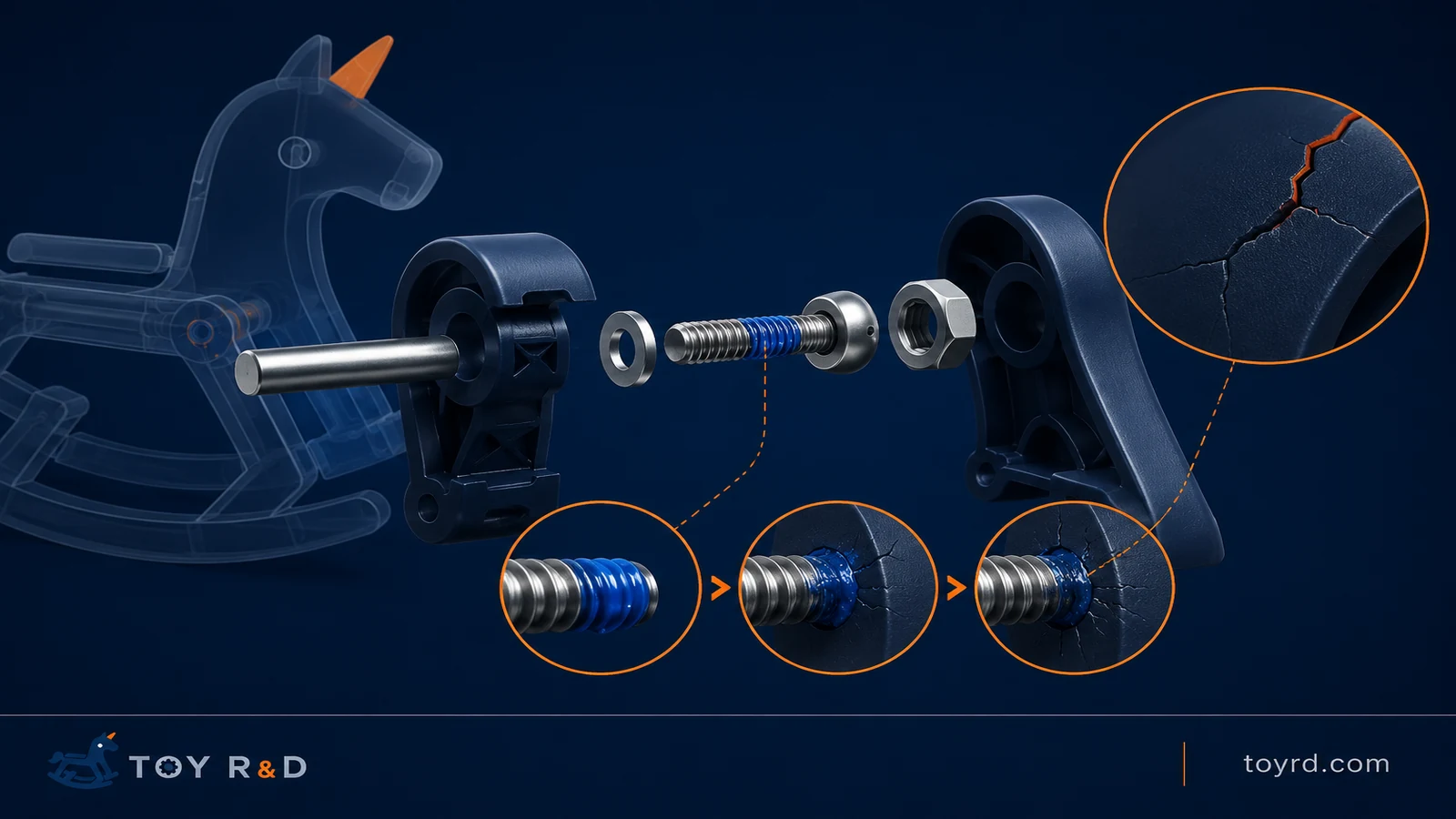
Excess liquid could run along the metal components and eventually reach nearby ABS parts.
At first, we did not realize how important this was.
Our attention remained focused on the mechanical structure itself:
Was the plastic part too weak?
Was the ABS wall too thin?
Was the moving mechanism creating an unexpected load?
Was assembly introducing excessive internal stress?
Did the structure simply need reinforcement?
We spent considerable time investigating why internal plastic parts were cracking.
Eventually, the investigation led us to something that had initially seemed almost irrelevant:
the threadlocker.
Anaerobic Threadlocker and ABS Can Be a Dangerous Combination
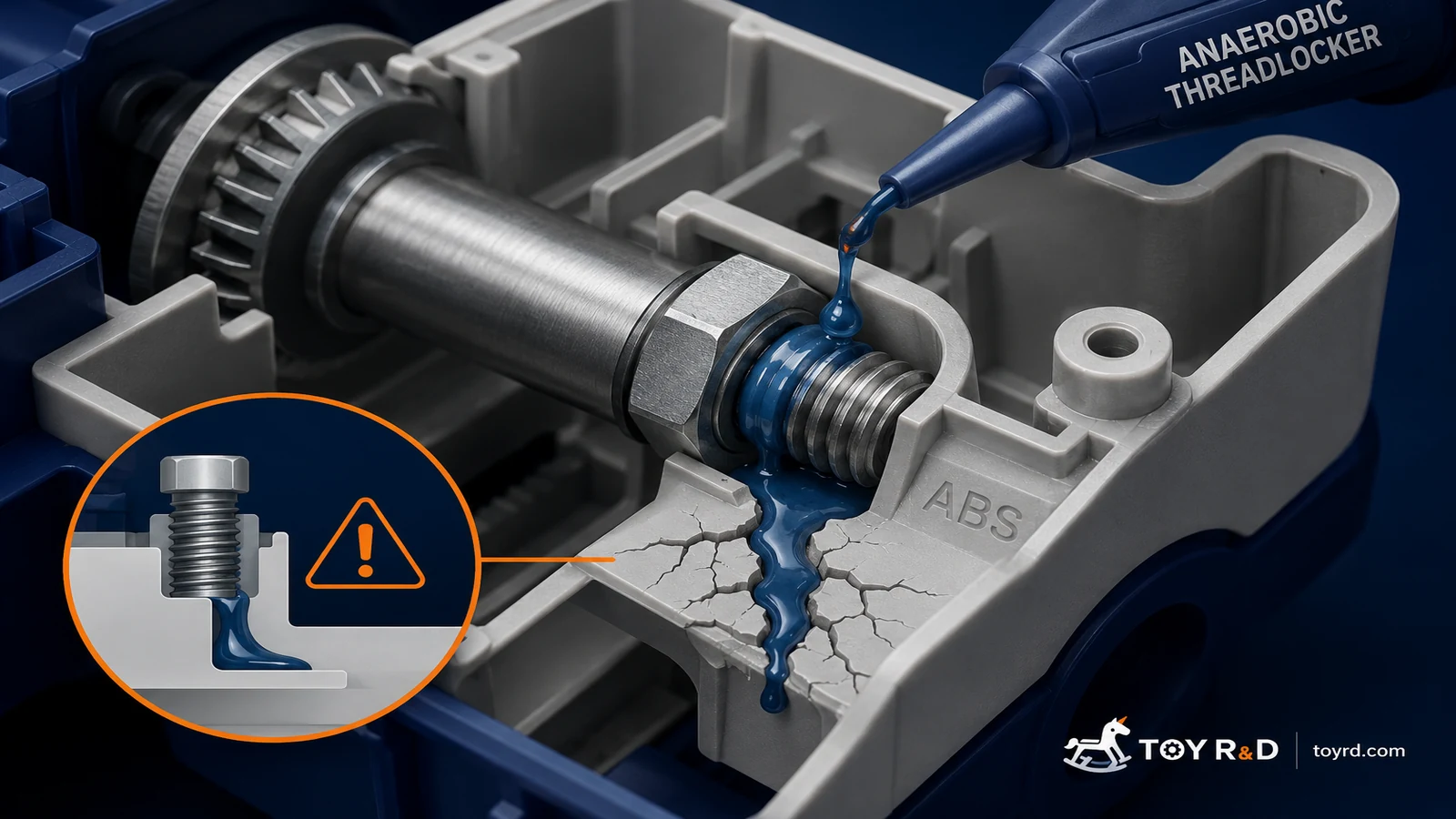
Many threadlocking compounds are designed specifically for metal threaded fasteners.
But there is an important distinction:
Being suitable for metal threads does not mean a chemical is compatible with every plastic surrounding those threads.
Certain threadlocking formulations or their chemical components can contribute to cracking, embrittlement, or environmental stress cracking (ESC) in plastics such as ABS.
What makes this kind of failure particularly difficult to diagnose is that it may not look like this:
“The chemical touched the plastic, and the plastic immediately cracked.”
The real situation can be much more subtle.
An ABS component may already contain stress from injection molding, screw fastening, snap-fit assembly, interference, or mechanical loading during operation.
When an incompatible chemical reaches an already stressed area, the material's ability to tolerate that stress can be reduced.
Eventually, what you see is simply:
The ABS cracked.
And that can easily lead an engineering team to blame the plastic geometry, wall thickness, or mechanical strength while overlooking the chemical sitting next to it.
“Tell the Operator to Use Less” Wasn't Our Final Solution
Once we identified the cause, the most obvious corrective action would have been to control the amount of threadlocker more carefully.
We could have introduced dispensing fixtures, stricter work instructions, operator training, and additional QC checks.
Those measures can certainly help.
But then we asked a different question:
What if this product didn't need threadlocker at all?
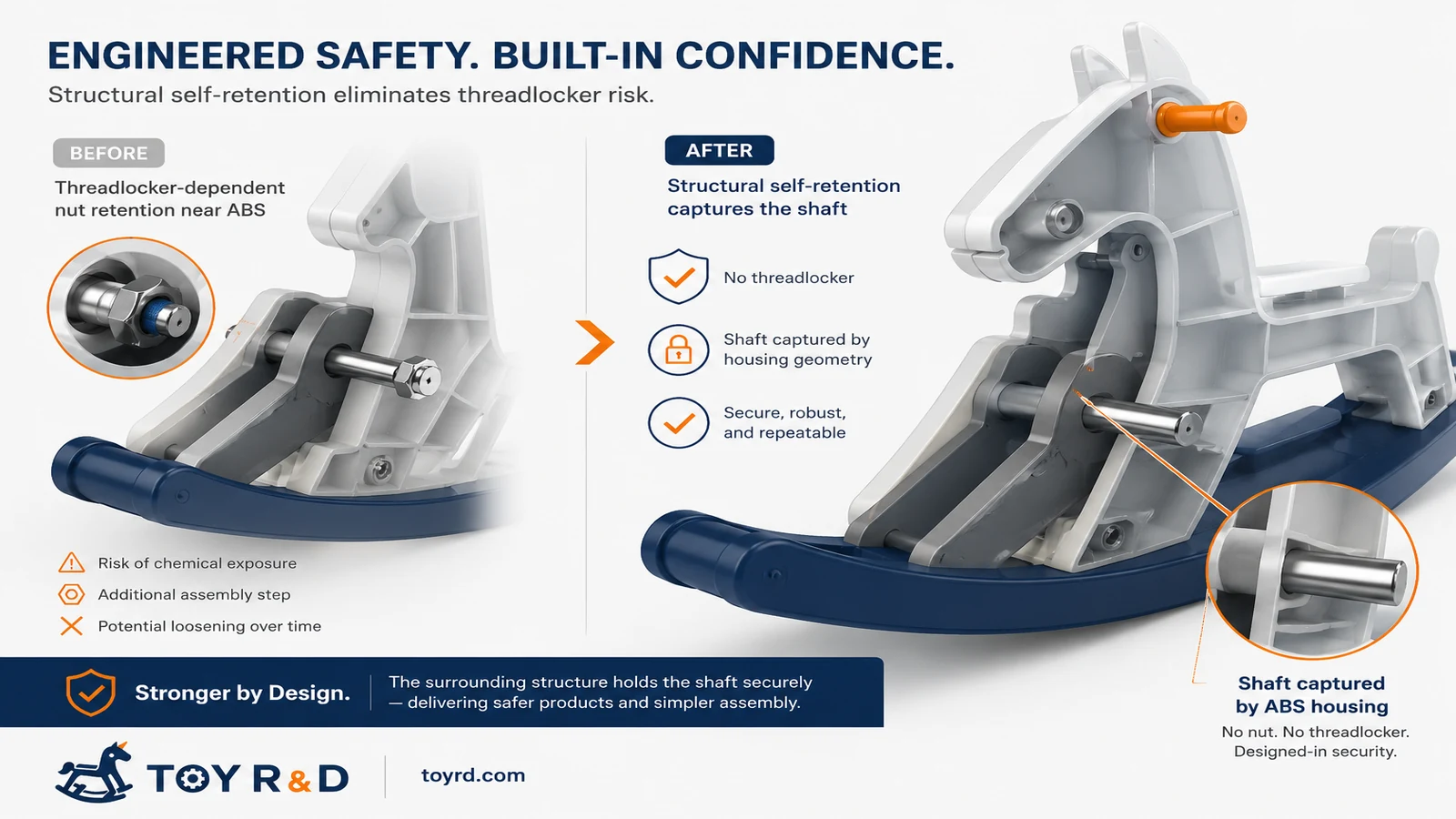
So we redesigned how the center shaft was retained.
The original design logic was:
Center shaft → screw/nut fastening → threadlocker to prevent loosening
The revised design became:
Center shaft → structural positioning → housing captures and retains the shaft
In other words, the shaft no longer depended on a tightened nut to remain in position. Instead, the surrounding housing and internal geometry physically constrained and located the shaft.
That broke the entire failure chain.
No nut that needed protection from loosening meant no need for threadlocker.
No threadlocker meant no possibility of excess adhesive reaching the ABS and creating a material-compatibility risk.
In the end, we did not simply learn to apply threadlocker more carefully.
We removed the need for it from the design.
Sometimes the Best Process Control Is Eliminating the Process
The lesson from this case goes beyond:
“Be careful when using threadlocker near ABS.”
There is a broader design-for-manufacturing principle behind it:
If avoiding a manufacturing failure requires operators to maintain precise control every single time, first ask whether the design can eliminate that risk altogether.
If a production instruction says:
“Apply only a tiny amount here.”
“Never let it flow onto this surface.”
“Every operator must control the quantity precisely.”
then the design deserves another look.
Building ten engineering samples and manufacturing ten thousand units are very different problems.
A robust mass-production design should not merely work under ideal conditions. It should reduce its dependence on operator skill, experience, and constant attention wherever practical.
At ToyRD, we apply this design-for-manufacturing mindset early—before a process-control requirement becomes a mass-production risk.
Material Compatibility Is an Easy Layer of Product Design to Miss
Toy development often brings many different materials and process chemicals together:
ABS, PC, PP, TPE, silicone, inks, paints, adhesives, lubricants, cleaning agents, threadlockers, and more.
It is easy to think about each one separately:
ABS is a structural material.
Threadlocker is an assembly aid.
Grease belongs to the mechanical mechanism.
Ink belongs to printing.
But inside a real product, all of these materials may eventually exist in the same physical space.
So material selection should not stop at asking:
“Is this material suitable for its intended function?”
We should also ask:
“What happens when it comes into contact with the materials around it?”
This is one of the areas we pay close attention to at ToyRD. Many mass-production failures are not caused by one obviously incorrect component. They happen at the intersections between materials, mechanical structures, assembly processes, and manufacturing reality.
From “How Do We Stop This From Failing?” to “How Do We Make This Failure Mode Disappear?”
Looking back, the most valuable part of this case was not simply discovering that a threadlocker could contribute to ABS cracking.
The more important lesson was how the problem-solving approach changed.
At first, we asked:
How do we make sure this screw never loosens?
That led us to threadlocker.
After discovering the problem, we could have asked:
How do we control the threadlocker more precisely?
Instead, we eventually asked:
Why does this joint need to depend on a tightened threaded fastener in the first place?
Once the question changed, the solution changed with it.
We redesigned the shaft retention so that the housing itself constrained the shaft, removing the risky assembly process at its source.
That is a principle worth remembering in product development:
Don't only optimize a problematic solution.
>
Sometimes the better design is the one that makes that solution unnecessary.
A small amount of threadlocker once led us to investigate cracked ABS parts.
What we gained from the experience was much bigger than a rule about adhesive compatibility.
It changed the way we looked at the design itself.
*ToyRD — Practical toy product development, engineering, manufacturing, and compliance insights from real-world development experience.*
toyrd.com