
*A real toy-development case showing why the best cost reduction sometimes comes from understanding a quotation—not simply pushing a supplier for a lower price.*
In toy development, small tooling charges appear everywhere.
A supplier may quote for an injection mold, silicone mold, printing jig, paint mask, spray fixture, assembly fixture, or some other production aid. The amount may only be a few hundred or a few thousand RMB, so it is tempting to approve it quickly and keep the project moving.
But small charges add up. More importantly, they often hide assumptions about how the supplier expects the product to be manufactured.
A recent silicone toy project gave us a good example.
The Original Quote: RMB 2,000
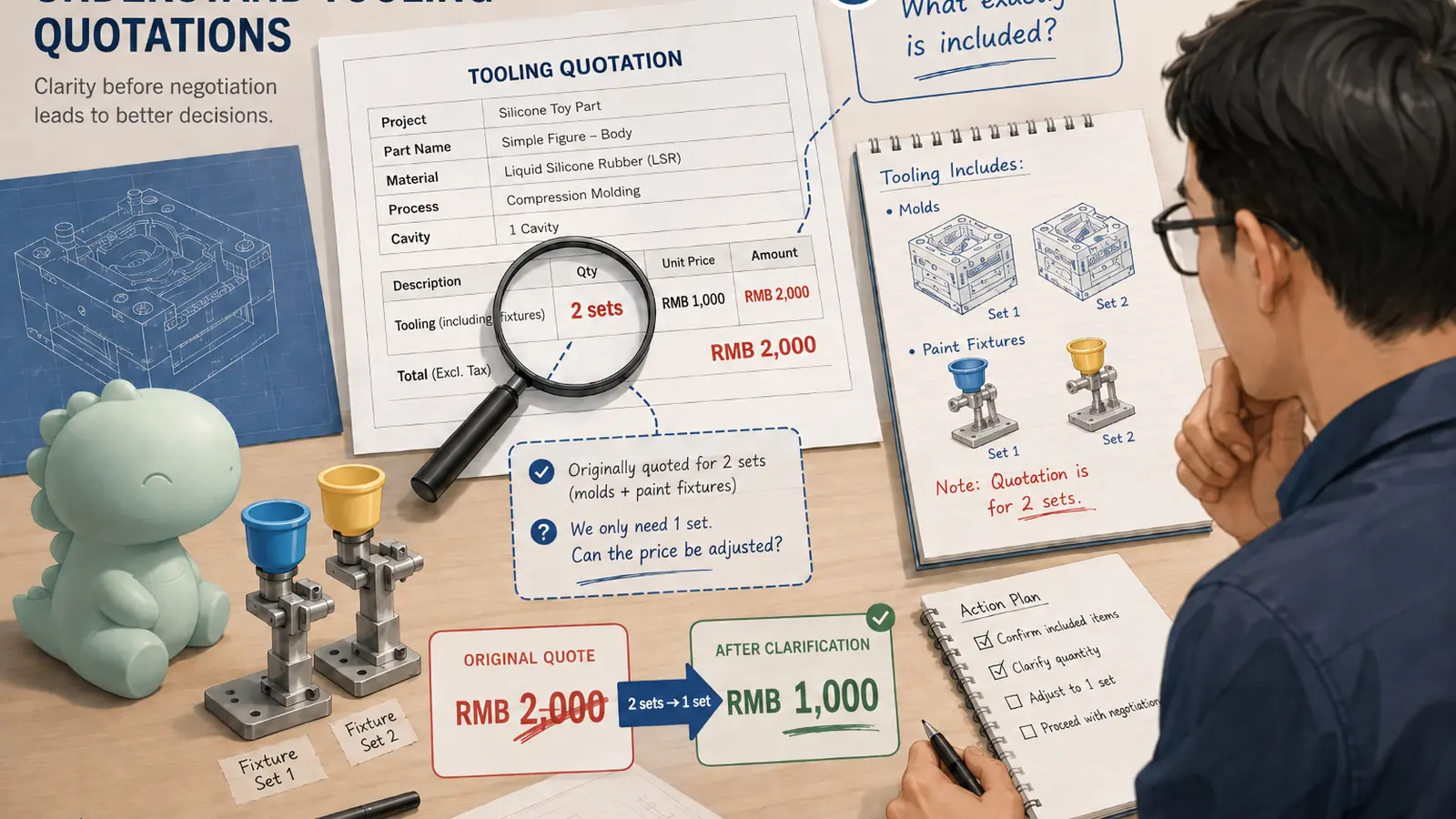
The product required two separate painted areas. To keep the paint in the correct position during production, the supplier's painting subcontractor needed dedicated spray fixtures.
The quotation was:
- Spray fixture A: RMB 1,000
- Spray fixture B: RMB 1,000
- Total: RMB 2,000
At first glance, the price looked high.
We had already asked another source about similar masking fixtures, and the indicative price was only a few hundred RMB each.
The obvious reaction would have been:
"Your price is too high. Can you reduce it?"
That is how many sourcing discussions begin.
But price negotiation was not actually the most useful first step.
Instead, we asked a different question:
What exactly is included in the RMB 1,000?
That question changed the whole conversation.
The Quote Was Based on Two Sets, Not One
After checking with the painting factory, the supplier came back with an important detail:
Each RMB 1,000 quotation included two identical sets of the fixture.
The painting factory had apparently quoted according to its normal production arrangement. Two sets would give them more flexibility during mass production and help maintain throughput if both were needed on the line.
That may be reasonable for a larger or faster production run.
But it was not what our project needed at this stage.
We were dealing with a relatively small production quantity. We asked whether one set of each fixture would be enough and whether using only one set would affect the delivery schedule.
The answer was yes: one set was enough, and it would not delay the small production run.
So the quotation was revised to:
- Spray fixture A: 1 set, RMB 500
- Spray fixture B: 1 set, RMB 500
- New total: RMB 1,000
The tooling cost was reduced by 50%.
But technically, we did not negotiate a lower unit price.
We corrected the assumption behind the quotation.
We didn't negotiate the price. We corrected the assumption behind the quote.
That distinction matters.
Price Problems Are Often Specification Problems
When two suppliers quote very different prices, it is easy to conclude that one is expensive.
Sometimes that is true.
But before making that judgment, check whether they are actually quoting the same thing.
For a small production fixture, useful questions include:
- What material is the fixture made from?
- How many pieces or sets are included?
- Why are multiple sets necessary?
- Is the fixture designed for sampling, a pilot run, or full mass production?
- What production volume is the quoted configuration intended to support?
- Does the price include adjustment or trial fitting?
- Does it include replacement if the fixture wears out?
- Who owns the fixture after it is paid for?
A quote of RMB 200 and a quote of RMB 1,000 may look wildly different until you discover that one supplier is quoting one simple mask while the other is quoting multiple production-ready fixtures plus setup work.
The first task is not to bargain.
The first task is to understand what you are buying.
Do Not Pay Today for Production Capacity You May Need Tomorrow
This case also reflects a broader issue in toy development.
Suppliers often think in terms of production efficiency. That is understandable. Their job is to keep factories running smoothly.
Product developers, however, have a different problem: uncertainty.
A new toy may begin with:
- a prototype,
- a customer sample,
- a 500-piece test order,
- a 1,000-piece pilot run,
- or a small first production order.
Nobody knows yet whether it will eventually become a 20,000-piece product.
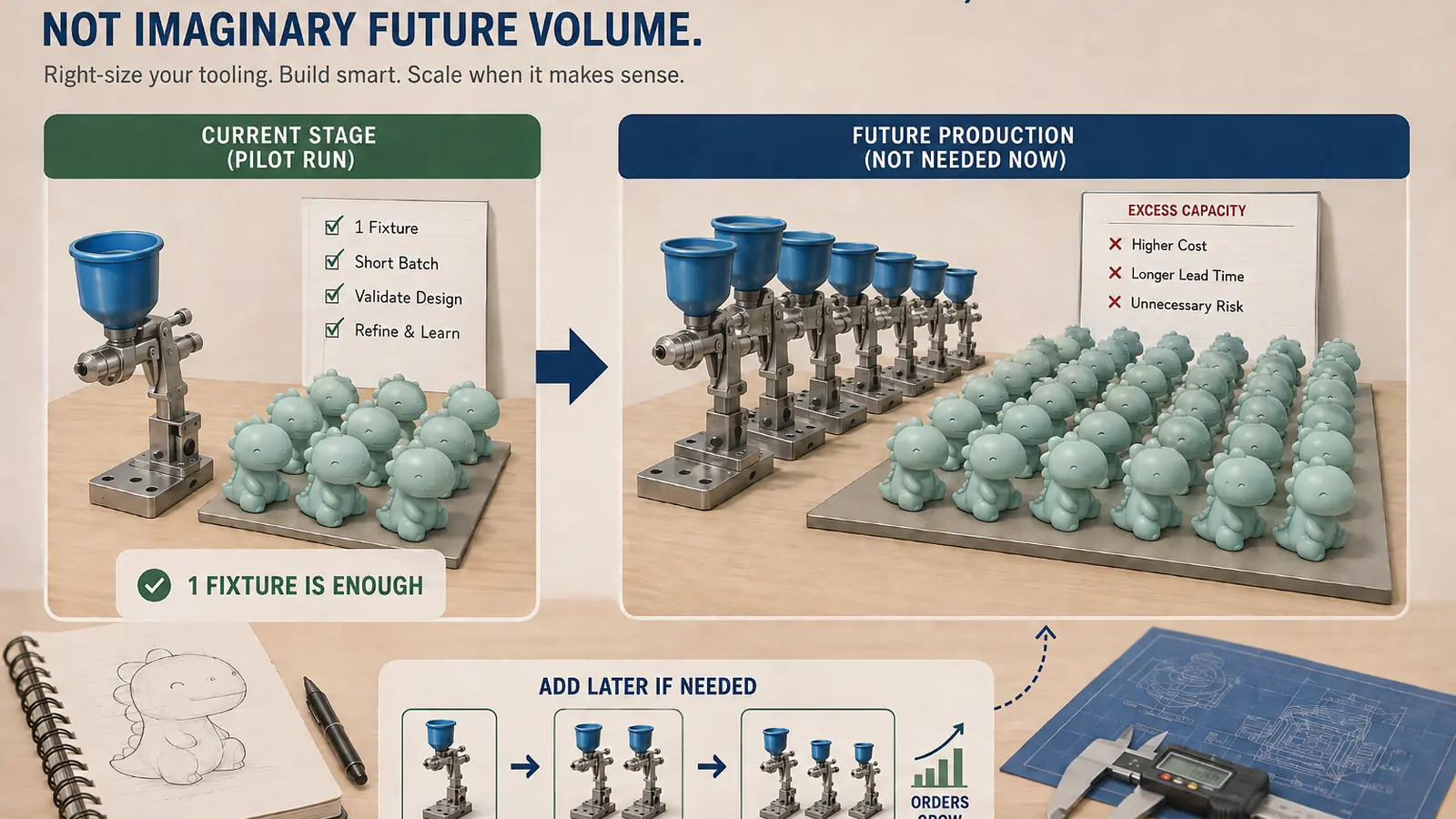
If the supplier automatically prepares tooling for future high-volume production, the customer may end up paying for capacity that is not currently necessary.
This is especially important for ODM and new-product projects.
A useful principle is:
Tooling should match the current stage of the product, not the imaginary future volume.
If the product succeeds and production increases, additional fixtures can be added later.
That is usually better than building every possible backup fixture before the market has validated the product.
In our case, there was no reason to pay for two sets immediately when one set could support the current order without affecting delivery.
The Cheapest Fixture Is Not Always the Best Decision
There was another interesting part of this case.
We could probably have found an outside supplier willing to make the fixtures for less than RMB 500 per set.
So why not simply buy the cheapest fixtures ourselves and send them to the painting factory?
Because tooling cost is only one part of the decision.
The other part is process responsibility.
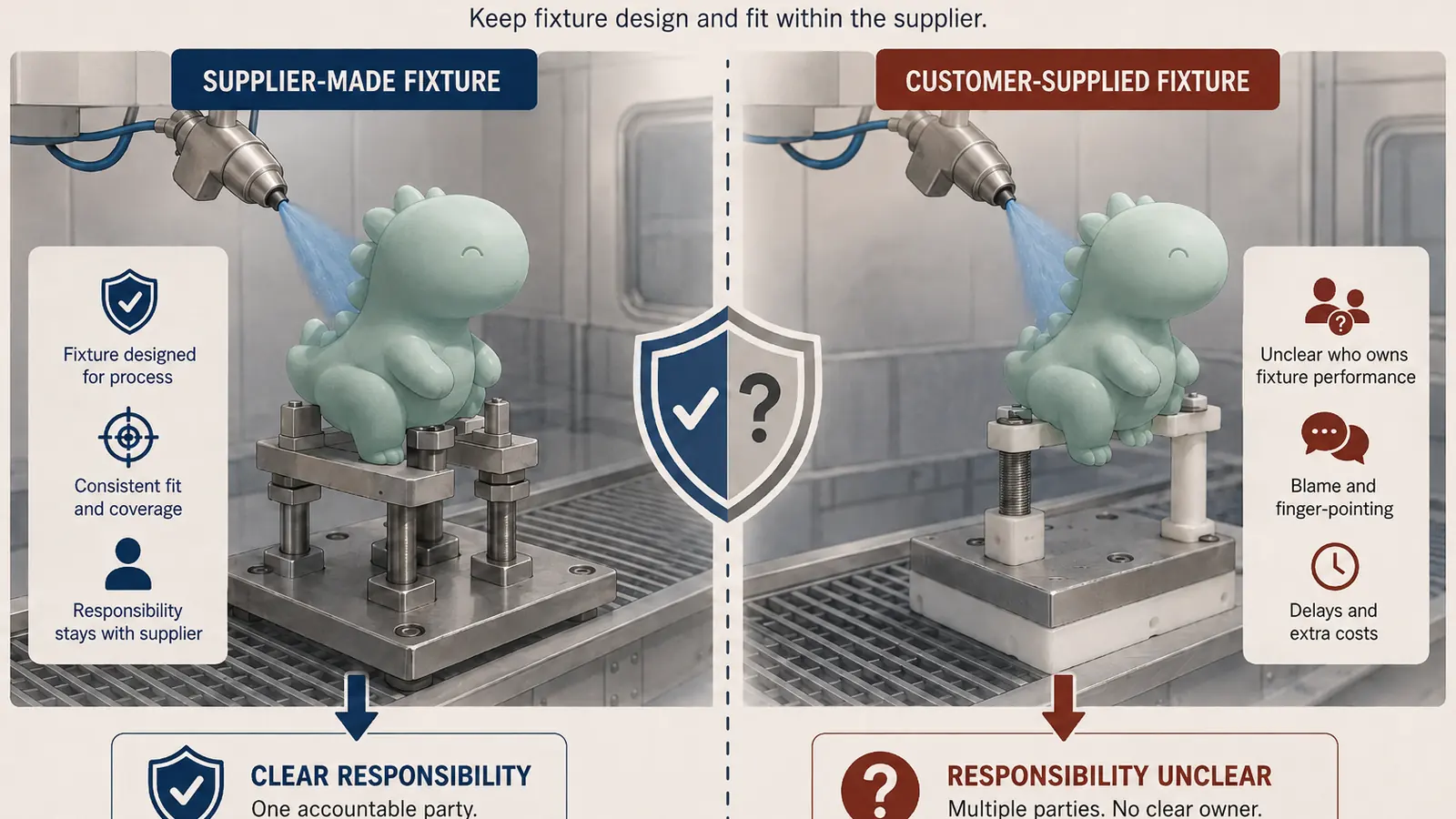
If the painting factory designs and makes its own fixture, then problems such as these stay within its process:
- paint position is incorrect,
- masking edges are poor,
- the part does not locate properly,
- the fixture does not fit consistently,
- overspray becomes excessive,
- or production becomes unstable.
The supplier has to solve the problem as part of delivering an acceptable finished component.
If we design or purchase the fixture ourselves and hand it to the factory, responsibility becomes less clear.
If the painted result is poor, the factory may reasonably say:
"The fixture was supplied by you."
Then a few hundred RMB of tooling savings can turn into a much more expensive argument about who is responsible for the production problem.
This leads to another useful rule:
Sometimes you are not paying for the tool itself. You are paying to keep process responsibility with the supplier.
For small differences in price, that can be worth more than the savings.
"Mold" Is Often Too Broad a Word
This case also highlights a terminology problem that appears frequently in toy sourcing.
In everyday factory communication, people sometimes use the Chinese word *mó* (模) very loosely. It may be translated into English as "mold," even when the item is not really a production mold in the conventional sense.
But these are very different things:
- Injection mold
- Silicone compression mold
- Blow mold
- Printing jig
- Assembly jig
- Paint mask
- Spray fixture
- Positioning fixture
Their cost structures, lifetimes, materials, ownership, and production purposes are completely different.
When reviewing a quotation, do not rely only on the label in the spreadsheet.
Ask what the physical item actually is and what function it performs.
That one clarification can prevent a surprising amount of confusion.
A Practical Checklist Before Approving Small Tooling Charges
Before approving a tooling or fixture charge, I now think it is worth checking at least these eight questions:
1. What exactly are we buying? 2. How many sets are included in the quotation? 3. Why is that quantity required? 4. What production volume is the tooling intended to support? 5. Can the project start with fewer sets? 6. Who owns the tooling after payment? 7. Who is responsible if the tooling does not produce an acceptable result? 8. Under what conditions would additional tooling be required later?
For more expensive molds, the checklist should obviously go much further: mold life, cavity count, steel grade, modification responsibility, maintenance, storage, ownership, and transfer rights all matter.
But even for a small RMB 500 fixture, asking the right questions can improve both cost control and supplier accountability.
The Lesson Was Not About Bargaining
The most valuable part of this case was not saving RMB 1,000.
It was understanding why the extra RMB 1,000 appeared in the first place.
The supplier was not necessarily trying to overcharge us. Their subcontractor had simply quoted a production setup that included more fixture capacity than our current project needed.
Once that assumption became visible, the solution was straightforward.
No aggressive negotiation was required.
No supplier had to "lose" the negotiation.
We simply aligned the tooling configuration with the real production requirement.
That is a much healthier way to manage product development.
Toy sourcing is often described as a battle over price. In practice, some of the best cost reductions come from something much less dramatic:
Ask better questions.
Before telling a supplier that a quotation is too expensive, first make sure you understand exactly what they have quoted.
You may discover that the real problem is not the price at all.
It is the assumption behind it.
*ToyRD shares practical lessons from real toy-development work: product engineering, sourcing, tooling, manufacturing, compliance, and the small decisions that determine whether a toy can move successfully from idea to mass production.*
ToyRD.com