Tag: toy manufacturing

  • Before You Negotiate a Tooling Quote, Ask What It Actually Includes

    Before You Negotiate a Tooling Quote, Ask What It Actually Includes

    *A real toy-development case showing why the best cost reduction sometimes comes from understanding a quotation—not simply pushing a supplier for a lower price.*

    In toy development, small tooling charges appear everywhere.

    A supplier may quote for an injection mold, silicone mold, printing jig, paint mask, spray fixture, assembly fixture, or some other production aid. The amount may only be a few hundred or a few thousand RMB, so it is tempting to approve it quickly and keep the project moving.

    But small charges add up. More importantly, they often hide assumptions about how the supplier expects the product to be manufactured.

    A recent silicone toy project gave us a good example.

    The Original Quote: RMB 2,000
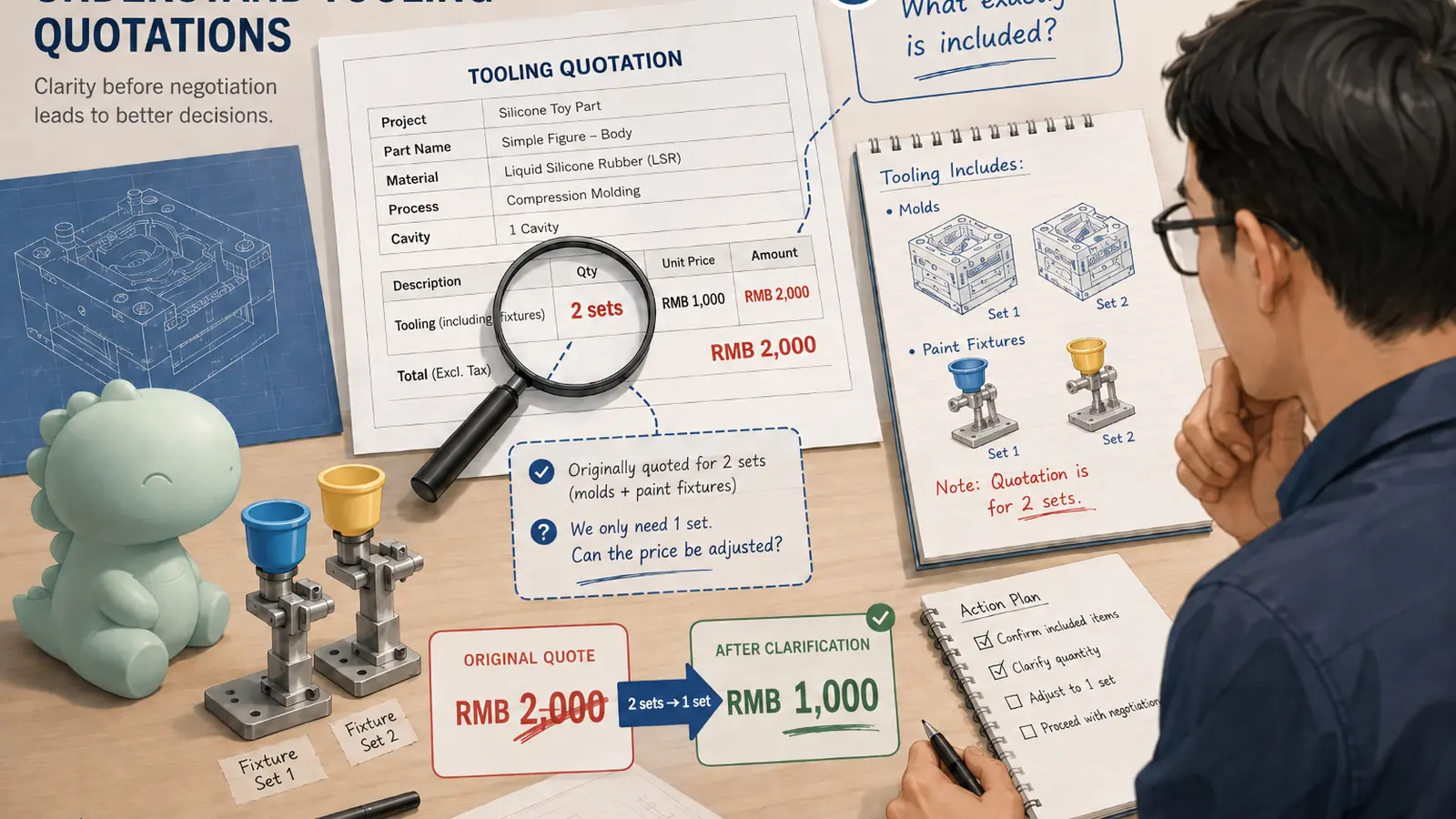
    Tooling quotation annotated to show that two fixture sets were included when one set was sufficient for the current run.
    Clarifying the quoted quantity can reduce cost without forcing a lower unit price.

    The product required two separate painted areas. To keep the paint in the correct position during production, the supplier's painting subcontractor needed dedicated spray fixtures.

    The quotation was:

    • Spray fixture A: RMB 1,000
    • Spray fixture B: RMB 1,000
    • Total: RMB 2,000

    At first glance, the price looked high.

    We had already asked another source about similar masking fixtures, and the indicative price was only a few hundred RMB each.

    The obvious reaction would have been:

    "Your price is too high. Can you reduce it?"

    That is how many sourcing discussions begin.

    But price negotiation was not actually the most useful first step.

    Instead, we asked a different question:

    What exactly is included in the RMB 1,000?

    That question changed the whole conversation.

    The Quote Was Based on Two Sets, Not One

    After checking with the painting factory, the supplier came back with an important detail:

    Each RMB 1,000 quotation included two identical sets of the fixture.

    The painting factory had apparently quoted according to its normal production arrangement. Two sets would give them more flexibility during mass production and help maintain throughput if both were needed on the line.

    That may be reasonable for a larger or faster production run.

    But it was not what our project needed at this stage.

    We were dealing with a relatively small production quantity. We asked whether one set of each fixture would be enough and whether using only one set would affect the delivery schedule.

    The answer was yes: one set was enough, and it would not delay the small production run.

    So the quotation was revised to:

    • Spray fixture A: 1 set, RMB 500
    • Spray fixture B: 1 set, RMB 500
    • New total: RMB 1,000

    The tooling cost was reduced by 50%.

    But technically, we did not negotiate a lower unit price.

    We corrected the assumption behind the quotation.

    We didn't negotiate the price. We corrected the assumption behind the quote.

    That distinction matters.

    Price Problems Are Often Specification Problems

    When two suppliers quote very different prices, it is easy to conclude that one is expensive.

    Sometimes that is true.

    But before making that judgment, check whether they are actually quoting the same thing.

    For a small production fixture, useful questions include:

    • What material is the fixture made from?
    • How many pieces or sets are included?
    • Why are multiple sets necessary?
    • Is the fixture designed for sampling, a pilot run, or full mass production?
    • What production volume is the quoted configuration intended to support?
    • Does the price include adjustment or trial fitting?
    • Does it include replacement if the fixture wears out?
    • Who owns the fixture after it is paid for?

    A quote of RMB 200 and a quote of RMB 1,000 may look wildly different until you discover that one supplier is quoting one simple mask while the other is quoting multiple production-ready fixtures plus setup work.

    The first task is not to bargain.

    The first task is to understand what you are buying.

    Do Not Pay Today for Production Capacity You May Need Tomorrow
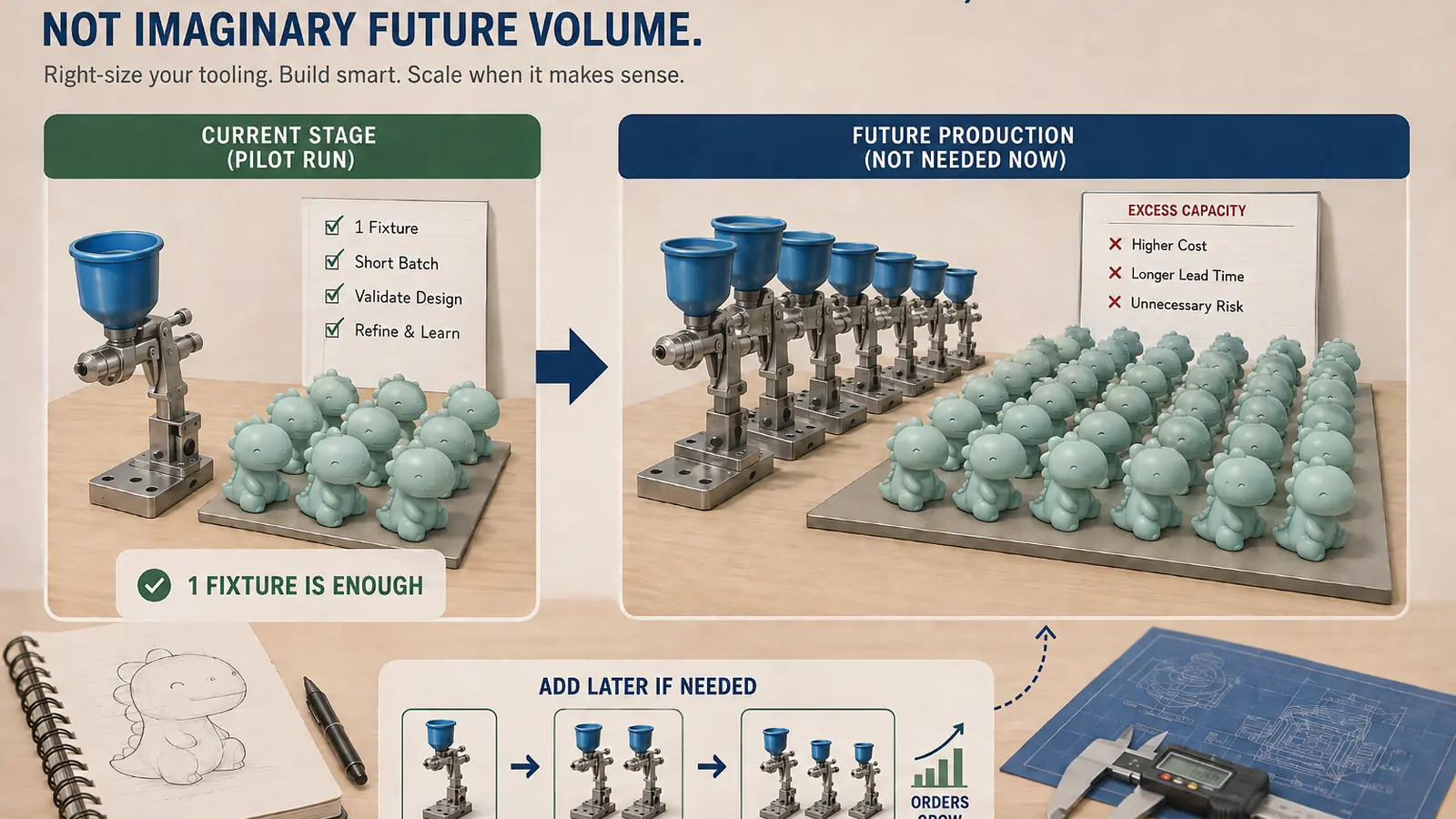
    Comparison showing one fixture for a pilot run and more fixtures only when future volume requires them.
    Build for the current production stage, then add capacity when the order volume justifies it.

    This case also reflects a broader issue in toy development.

    Suppliers often think in terms of production efficiency. That is understandable. Their job is to keep factories running smoothly.

    Product developers, however, have a different problem: uncertainty.

    A new toy may begin with:

    • a prototype,
    • a customer sample,
    • a 500-piece test order,
    • a 1,000-piece pilot run,
    • or a small first production order.

    Nobody knows yet whether it will eventually become a 20,000-piece product.

    If the supplier automatically prepares tooling for future high-volume production, the customer may end up paying for capacity that is not currently necessary.

    This is especially important for ODM and new-product projects.

    A useful principle is:

    Tooling should match the current stage of the product, not the imaginary future volume.

    If the product succeeds and production increases, additional fixtures can be added later.

    That is usually better than building every possible backup fixture before the market has validated the product.

    In our case, there was no reason to pay for two sets immediately when one set could support the current order without affecting delivery.

    The Cheapest Fixture Is Not Always the Best Decision
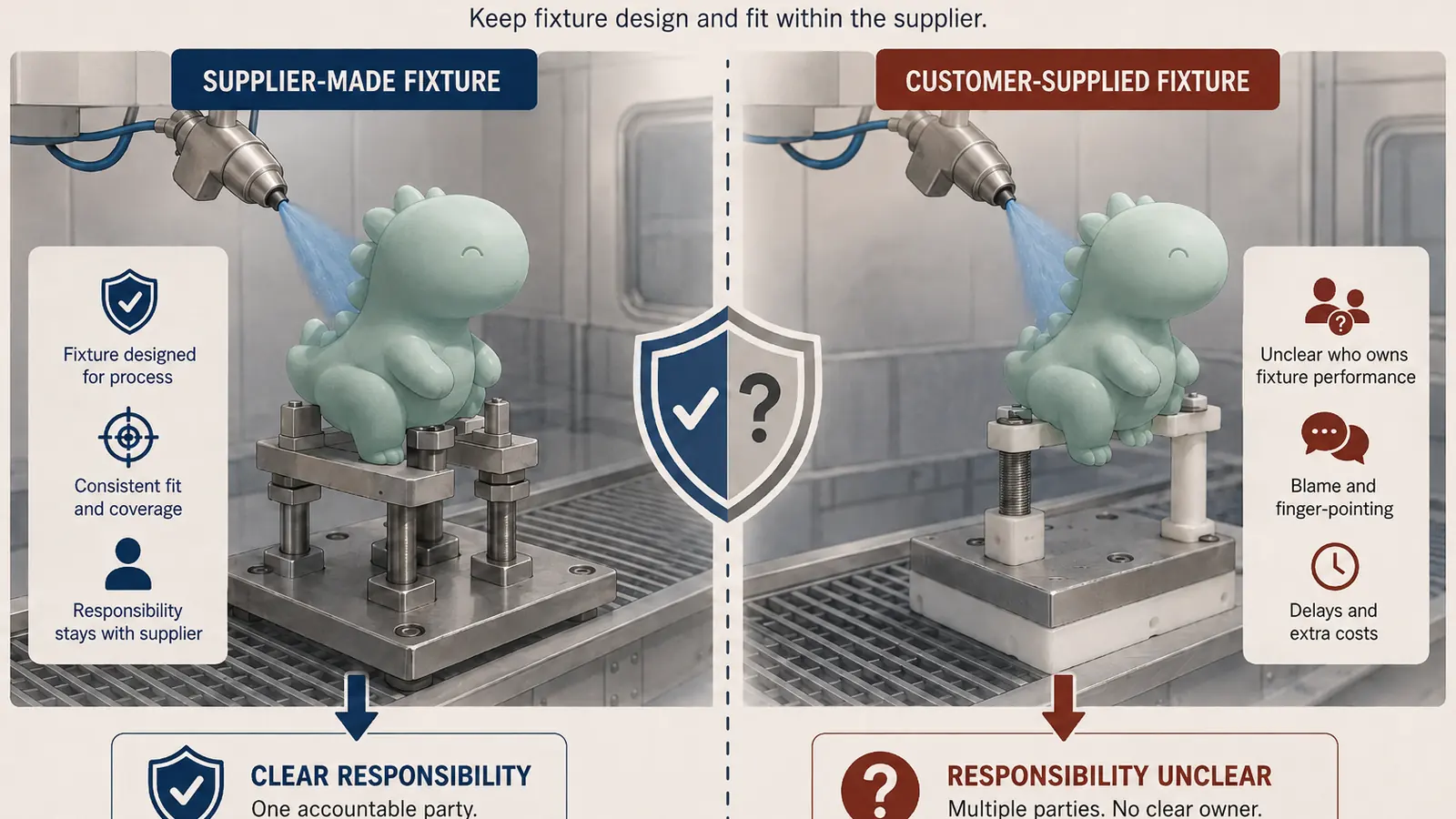
    Comparison of a supplier-made fixture with a customer-supplied fixture, showing why process responsibility should stay clear.
    Keeping fixture design with the supplier preserves clear responsibility for process performance.

    There was another interesting part of this case.

    We could probably have found an outside supplier willing to make the fixtures for less than RMB 500 per set.

    So why not simply buy the cheapest fixtures ourselves and send them to the painting factory?

    Because tooling cost is only one part of the decision.

    The other part is process responsibility.

    If the painting factory designs and makes its own fixture, then problems such as these stay within its process:

    • paint position is incorrect,
    • masking edges are poor,
    • the part does not locate properly,
    • the fixture does not fit consistently,
    • overspray becomes excessive,
    • or production becomes unstable.

    The supplier has to solve the problem as part of delivering an acceptable finished component.

    If we design or purchase the fixture ourselves and hand it to the factory, responsibility becomes less clear.

    If the painted result is poor, the factory may reasonably say:

    "The fixture was supplied by you."

    Then a few hundred RMB of tooling savings can turn into a much more expensive argument about who is responsible for the production problem.

    This leads to another useful rule:

    Sometimes you are not paying for the tool itself. You are paying to keep process responsibility with the supplier.

    For small differences in price, that can be worth more than the savings.

    "Mold" Is Often Too Broad a Word

    This case also highlights a terminology problem that appears frequently in toy sourcing.

    In everyday factory communication, people sometimes use the Chinese word *mó* (模) very loosely. It may be translated into English as "mold," even when the item is not really a production mold in the conventional sense.

    But these are very different things:

    • Injection mold
    • Silicone compression mold
    • Blow mold
    • Printing jig
    • Assembly jig
    • Paint mask
    • Spray fixture
    • Positioning fixture

    Their cost structures, lifetimes, materials, ownership, and production purposes are completely different.

    When reviewing a quotation, do not rely only on the label in the spreadsheet.

    Ask what the physical item actually is and what function it performs.

    That one clarification can prevent a surprising amount of confusion.

    A Practical Checklist Before Approving Small Tooling Charges

    Before approving a tooling or fixture charge, I now think it is worth checking at least these eight questions:

    1. What exactly are we buying? 2. How many sets are included in the quotation? 3. Why is that quantity required? 4. What production volume is the tooling intended to support? 5. Can the project start with fewer sets? 6. Who owns the tooling after payment? 7. Who is responsible if the tooling does not produce an acceptable result? 8. Under what conditions would additional tooling be required later?

    For more expensive molds, the checklist should obviously go much further: mold life, cavity count, steel grade, modification responsibility, maintenance, storage, ownership, and transfer rights all matter.

    But even for a small RMB 500 fixture, asking the right questions can improve both cost control and supplier accountability.

    The Lesson Was Not About Bargaining

    The most valuable part of this case was not saving RMB 1,000.

    It was understanding why the extra RMB 1,000 appeared in the first place.

    The supplier was not necessarily trying to overcharge us. Their subcontractor had simply quoted a production setup that included more fixture capacity than our current project needed.

    Once that assumption became visible, the solution was straightforward.

    No aggressive negotiation was required.

    No supplier had to "lose" the negotiation.

    We simply aligned the tooling configuration with the real production requirement.

    That is a much healthier way to manage product development.

    Toy sourcing is often described as a battle over price. In practice, some of the best cost reductions come from something much less dramatic:

    Ask better questions.

    Before telling a supplier that a quotation is too expensive, first make sure you understand exactly what they have quoted.

    You may discover that the real problem is not the price at all.

    It is the assumption behind it.

    *ToyRD shares practical lessons from real toy-development work: product engineering, sourcing, tooling, manufacturing, compliance, and the small decisions that determine whether a toy can move successfully from idea to mass production.*

    ToyRD.com
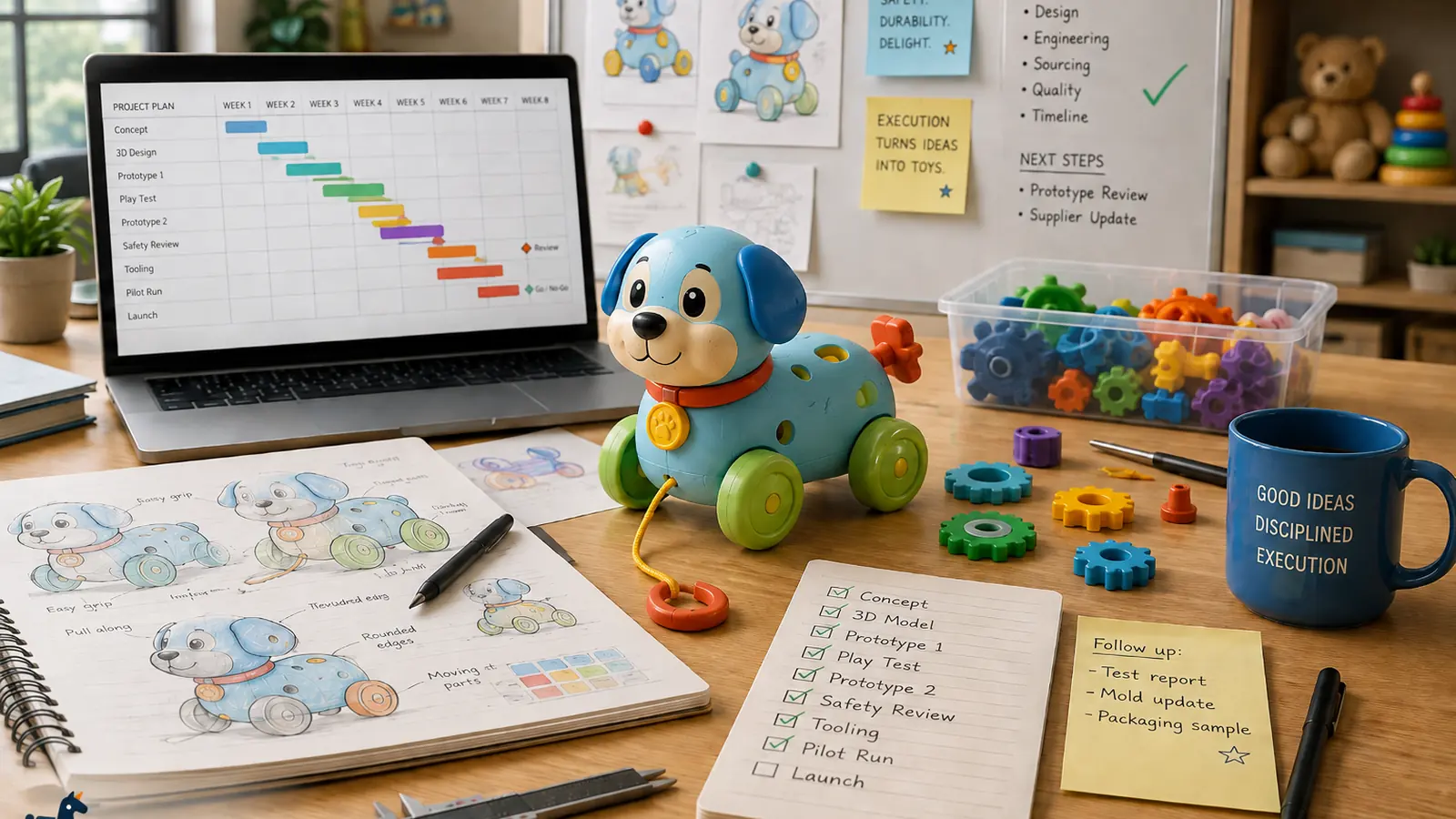
  • Many Toy Projects Don’t Fail Because of the Idea — They Fail Because of Execution

    Many Toy Projects Don’t Fail Because of the Idea — They Fail Because of Execution

    When a toy project begins, most people naturally focus on the idea.

    Is the design attractive enough? Is the function innovative? Will customers like it? Will it make people stop and take a closer look at a trade show?

    But after spending enough time in product development, I have gradually come to believe that many projects do not fail because of the idea. They fail because of execution.

    A good concept may miss a customer’s internal review simply because the sample was two weeks late. A project that was already close to approval may slowly lose momentum because the supplier keeps delaying the sample. A product that still has room for cost optimization may end up in endless price negotiations simply because the quotation only shows one total number, with no visibility into where the cost actually comes from.

    None of these sound like “technical problems.”

    But in reality, they often have a bigger impact on whether a project succeeds than the technical problems themselves.

    Deadlines Matter, but a Deadline Alone Does Not Prevent Delays

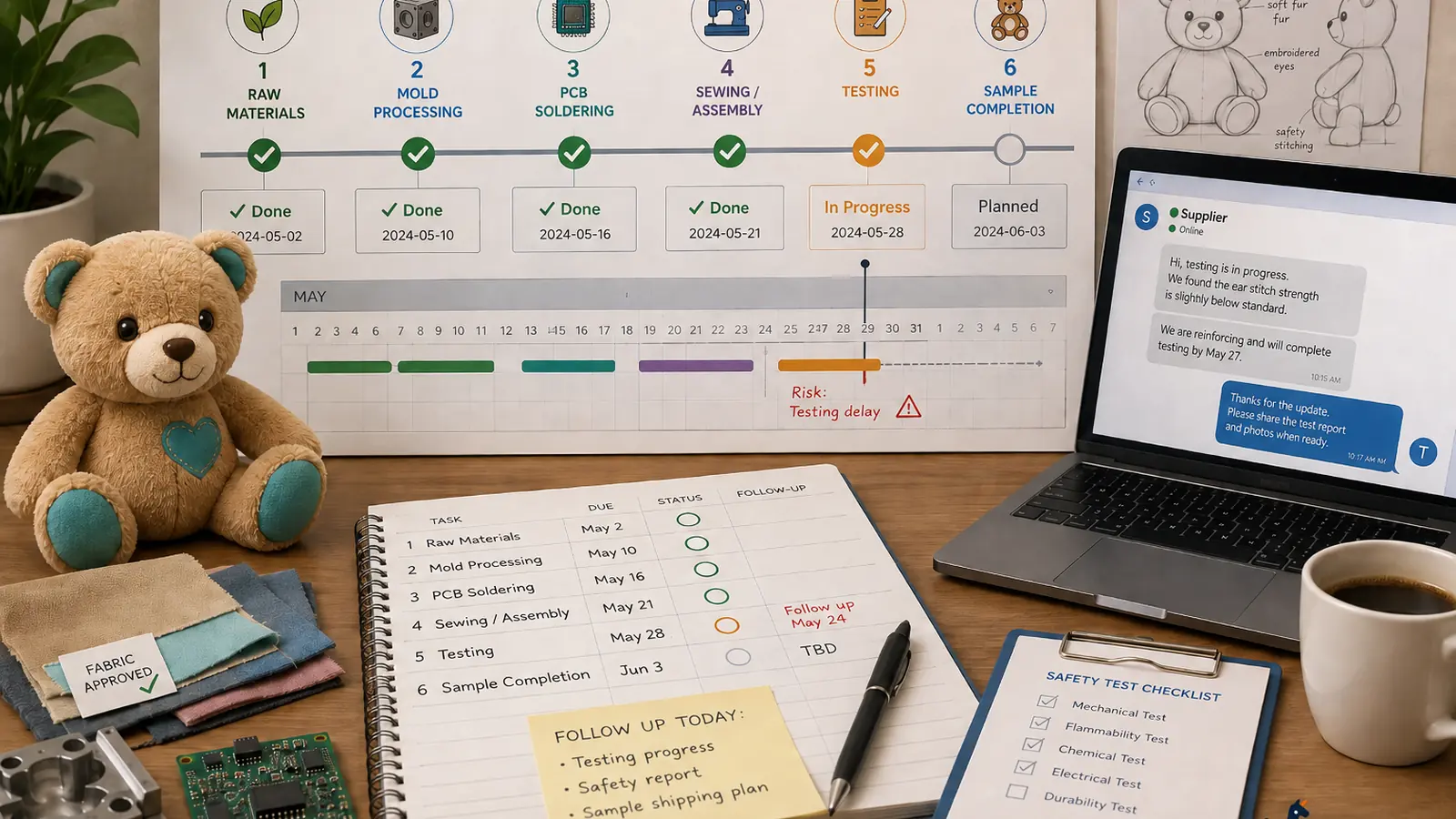
    Toy manufacturing checkpoint board, supplier update, test checklist, fabric samples, and electronics board.
    Smaller, verifiable checkpoints make delays visible early enough to act.

    When we work with suppliers, we normally give them a clear deadline.

    For example, a prototype, tooling sample, PCB sample, or packaging sample may need to be completed by a certain date. To be safe, we usually start following up one or two days before the deadline.

    This is a very common approach.

    But the reality is simple:

    Even if you start chasing in advance, the sample can still be late.

    I used to think the main reason was that the supplier lacked execution, or that our project was not high enough on their priority list.

    Those situations certainly happen.

    But I later realized that the bigger problem is this:

    By the time you discover that the project is going to be delayed, it is often already too late.

    A deadline is only the final point in time.

    Imagine that a supplier originally planned to prepare materials on Monday, process parts on Tuesday, assemble on Wednesday, and test on Thursday.

    If something already went wrong on Tuesday, but you do not ask about progress until Thursday, then no matter how urgently you chase them, the lost time is already gone.

    So instead of only “chasing the deadline,” a more effective method is to break one large deadline into several smaller checkpoints that can actually be verified.

    For example:

    • Have the raw materials arrived?
    • Has machining started?
    • Has the PCB been soldered?
    • Has the plush sewing been completed?
    • Has the mold gone onto the machine?
    • Can you send a photo of the current sample status?
    • What exactly is blocking progress today?

    The purpose of these questions is not to put more pressure on the supplier.

    The value is that they help you discover earlier when the project has already started drifting away from the original plan.

    If you know on Tuesday that a key part still has not arrived, the R&D team still has time to decide:

    Should we wait?

    Should we switch suppliers?

    Should we build a functional sample first?

    Should we send the completed parts to the customer for early confirmation?

    The real value is not how much faster you can push the supplier at the end.

    It is knowing a few days earlier that the target date may no longer be realistic.

    Those few days are often where project management can actually recover time.

    One Core Part of R&D Management Is Making Risk Visible Earlier

    A lot of R&D work appears to be about managing the product.

    Drawing, revising structures, confirming electronics, testing functions, approving samples, following tooling, following packaging.

    But if you step back, you realize that a large part of what an R&D manager actually deals with every day is information.

    Who is working on what?

    Which part of the project is already at risk?

    When a supplier says “no problem,” is there really no problem — or have they simply not started yet?

    When must the customer see the sample?

    Which issue, if left unresolved today, will affect the whole project three days later?

    So project management is not only about assigning a completion date.

    More importantly, it is about creating a mechanism that allows bad news to appear as early as possible.

    That may sound counterintuitive.

    Everyone likes to hear “yes,” “no problem,” and “we can make it.”

    But in product development, the earlier you know that something may not make it in time, the safer the project becomes.

    Because there is still time to adjust.

    The most dangerous situation is not that a problem exists.

    It is that the problem has already existed for days while everyone still believes the project is on track.

    Quotation Works the Same Way: One Total Price Is Often Not Enough

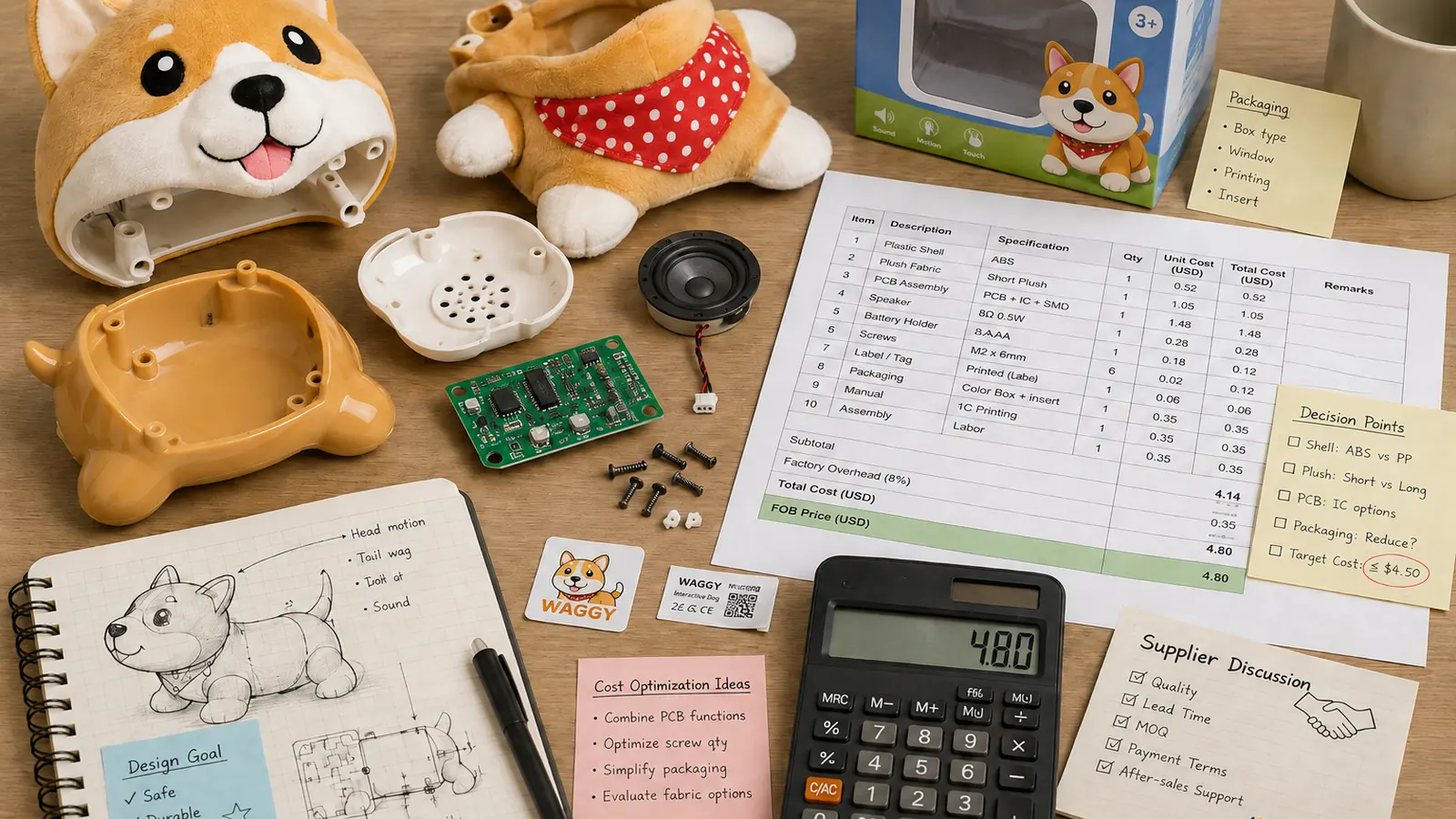
    Toy components, cost sheet, calculator, packaging notes, and product sketch used to review toy development cost.
    A transparent quotation makes cost a design decision, not just a negotiation.

    Another interesting thing I have seen is how some highly experienced buyers handle quotations.

    When they receive a price, they rarely look only at the final number.

    They keep breaking it down.

    How much is the plastic?

    How much is the electronics?

    How much is the speaker?

    How much is the plush material?

    How much is the packaging?

    How much is the labor?

    How much could be saved by removing one printing process?

    How much could be saved by changing one component to a different material?

    At first, this style of purchasing can feel like the buyer is simply trying to negotiate every line item down.

    But over time, I have come to appreciate the logic behind it.

    Because professional cost control is not really asking:

    “Can you make it cheaper?”

    It is asking:

    “Where is the cost coming from?”

    These two questions may sound similar, but they lead to completely different conversations.

    The first usually has only one outcome: the supplier gives up a little more margin.

    The second can actually change the product.

    For example, a product may be too expensive not because the supplier’s margin is too high, but because:

    • one component uses an unnecessarily high material specification;
    • there are too many printing processes;
    • a metal part is structurally too complicated;
    • the packaging volume is too large;
    • the PCB includes components that are not really necessary;
    • one cosmetic effect requires an additional production process;
    • the order quantity is too small to spread fixed costs efficiently.

    Once these costs are broken down, R&D, purchasing, and the customer can make much better decisions together.

    Maybe the customer wants to keep the appearance but remove one function.

    Maybe the electronics specification cannot be reduced, but the packaging can be optimized.

    Maybe one expensive component is actually a key selling point, and another cost item should be changed instead.

    The purpose of breaking down a quotation is not only to push the price lower. It is to turn cost into something that can be understood, discussed, traded off, and designed.

    Good R&D Is Not Just About Getting the Product Made

    I used to think of R&D mainly as “solving technical problems.”

    Now I think that definition is too narrow.

    A mature R&D engineer — or a mature R&D team — does not only need to make the product work.

    They also need to keep asking several very practical questions:

    Is the timeline still under control?

    Are we spending money on the parts that truly create value?

    Are risks being discovered early enough?

    Are the supplier, purchasing team, engineers, and customer all working with the same information?

    Very often, what determines whether a toy project succeeds is not one brilliant idea.

    It is a collection of small, unglamorous execution details.

    Was the deadline broken into process checkpoints?

    When the supplier said “almost finished,” did anyone verify the actual progress?

    When the quotation came in, did anyone understand the real cost structure?

    When a risk appeared, was it discovered on the final day — or one week earlier?

    These things rarely appear in a product brochure.

    And people rarely talk about them.

    But they are a very real part of toy development.

    That is also what I hope to keep documenting on ToyRD:

    Not only how a toy should be designed, but how a toy is actually developed and made inside a real supply chain.

  • Why Global Toy Buyers Should Know Chenghai’s Toy Manufacturing Ecosystem

    Why Global Toy Buyers Should Know Chenghai’s Toy Manufacturing Ecosystem

    If you have worked in the toy industry for any length of time, you have probably heard the name Chenghai.

    But for many overseas consumers—and even for some buyers who are new to the industry—Chenghai is still just a small and relatively unknown place on the map.

    Located in Shantou, Guangdong Province, China, Chenghai covers an area of less than 400 square kilometers. Yet its toy manufacturing ecosystem reaches far beyond its footprint.

    Here, toys are not simply the business of a few individual factories. They are part of an entire city-level industrial ecosystem.

    According to a 2025 report on the development of Chenghai’s toy and creative industries, the region is home to around 68,000 toy-related manufacturing and business entities. Products made here are exported to more than 170 countries and regions, and Chenghai’s plastic toy production capacity is estimated to account for roughly one-third of the global total.

    But what makes Chenghai truly special is not just the numbers.

    Within a remarkably small geographic area, you can turn a toy idea into a real commercial product.

    Chenghai’s Real Advantage Is Not Just Low Cost

    When people talk about manufacturing in China, cost is often the first thing that comes to mind.

    But if I had to explain Chenghai’s biggest competitive advantage today, price would not be the first thing I mentioned.

    I would say: speed.

    A mature toy project may involve product design, 3D engineering, prototype development, tooling, injection molding, electronics, PCB development, IC solutions, speakers, motors, LEDs, silicone parts, plush components, printing, spray painting, pad printing, packaging, testing, certification, assembly, and logistics.

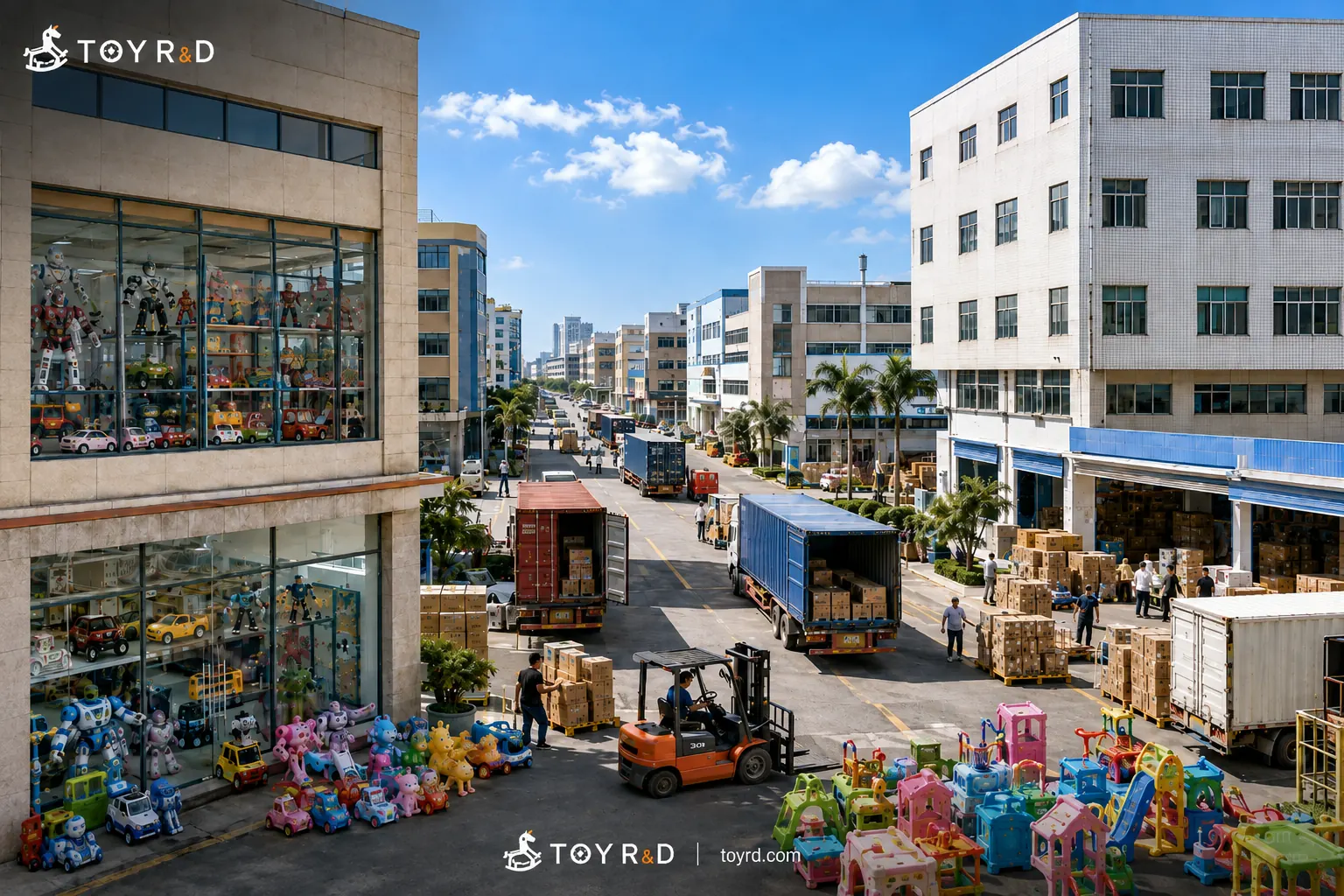
    In many places, this means managing a dozen or even dozens of suppliers spread across different cities. In Chenghai, many of those suppliers may be within a 30-minute drive.

    The area has developed a highly concentrated supply chain covering product development, design, IP, raw materials, tooling, injection molding, assembly, trading, exhibitions, warehousing, and logistics.

    The result is a level of efficiency that cannot be explained simply by lower labor costs.

    If a structural problem is discovered in the morning, you can visit the mold maker that afternoon. If the electronics do not perform as expected, you can take the sample directly to the electronics solution provider. If the lighting effect is poor, you can change the LED, redesign the light guide, modify the firmware, and test again.

    Silicone too hard? Change the Shore hardness. Sound quality not good enough? Change the speaker, amplifier, sampling rate, or acoustic chamber. Packaging dimensions not right? Adjust the die line and make another sample.

    For toy development, this density of suppliers is incredibly valuable.

    The Hardest Part of Toy Development Is Often the Final 20%

    Creating a prototype that can move, light up, or make sounds is usually not the hardest part. The difficult part is turning that prototype into a product that can be manufactured reliably in quantities of 10,000 or 100,000 units—while keeping each unit as close as possible to the original design intent.

    A toy that looks very simple can reveal dozens of problems once mass production begins: gears that are too noisy, short battery life, uneven LED brightness, buttons that do not feel right, plastic parts that shrink or deform, batch-to-batch color variation, shifted printing, inconsistent plush filling, speakers that sound different inside the housing, clips that fail drop tests, or structures that must be redesigned to pass a safety test.

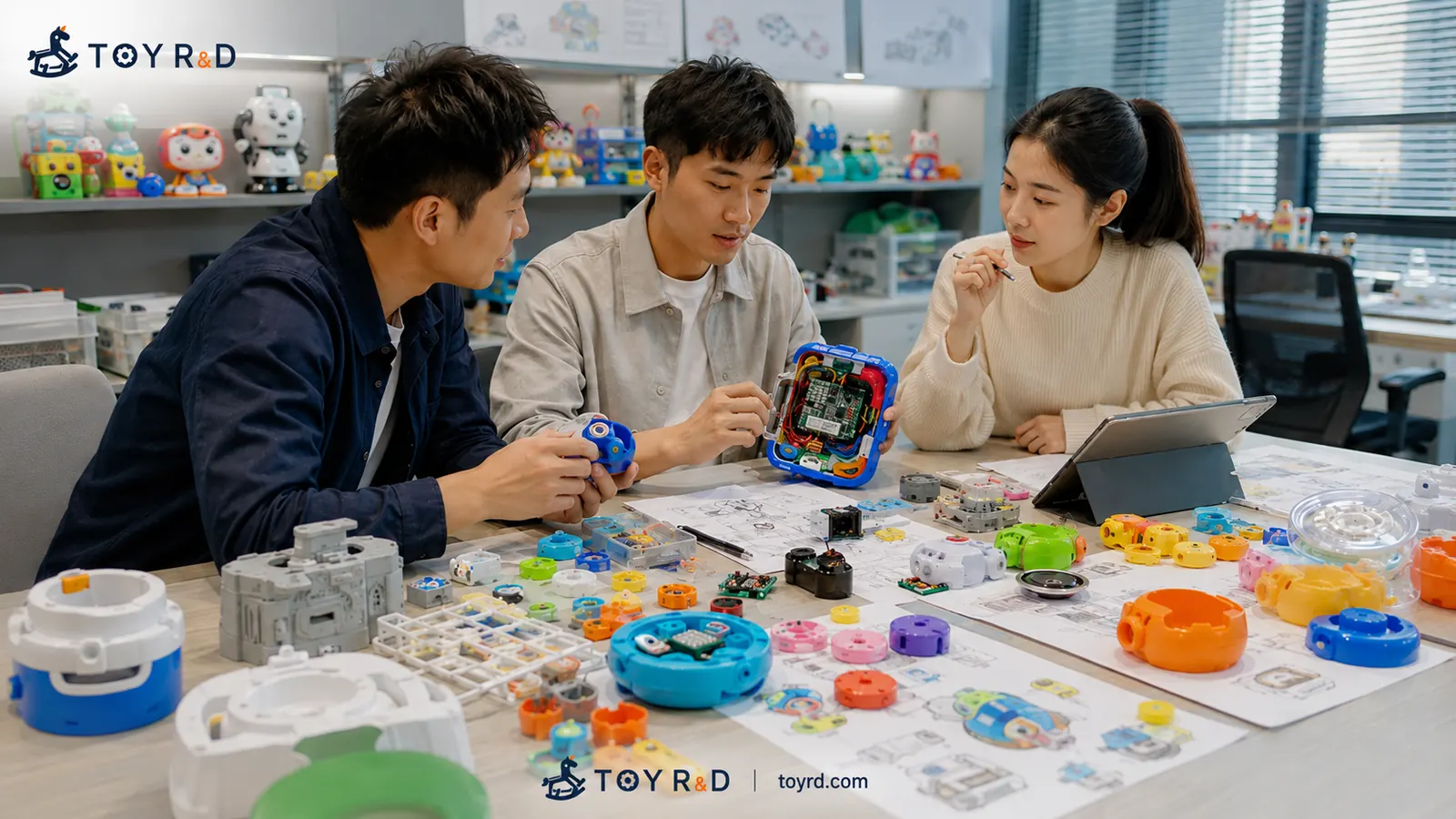
    Toy development engineers reviewing an electronic toy prototype and components
    Rapid iteration between design, electronics, tooling, and production is central to toy development.

    That is why toy development depends so heavily on experience and supply-chain collaboration.

    One of Chenghai’s greatest strengths is that people here deal with these problems every single day—not a few new toys every year, but a continuous stream of new projects, modifications, trial runs, and mass-production launches across thousands of companies, engineers, mold makers, electronics suppliers, and subcontractors.

    That experience accumulates over time.

    From an Idea to a Product You Can Actually Quote

    Imagine a European customer comes to you with an idea:

    “I want to make a baby soothing toy that lights up, plays music, and reacts to sound.”

    That one sentence is still a long way from a real product. Many questions must be answered first: What material should be used? What is the intended age grade? Should it use AA batteries or a rechargeable lithium battery? What kind of audio IC and speaker are suitable? How should the LED light be diffused? Where should the sound sensor be positioned? Will motor noise interfere with sound detection? Should the body be plastic or silicone? How many molds are required? How will the product be assembled, packaged, quoted, and assessed for its target-market requirements?

    No single supplier can answer all of these questions alone. What is really needed is a network of specialized suppliers. That is exactly where Chenghai is strong.

    Small Orders and Fast Experimentation Matter Too

    The modern toy market is changing. In the past, large brands could invest heavily in tooling and rely on huge order volumes to spread out those costs.

    Today, more brands want to start with a small production run, test a product at a trade show, evaluate market response, see how customers react on Amazon or TikTok, and then scale up only if the product performs well.

    That means a toy supply chain must do more than support mass production. It must also support fast experimentation.

    The large number of small and mid-sized suppliers in Chenghai can actually be an advantage in this environment. You can begin with a prototype, make an engineering sample, modify the structure, open the mold, adjust it after the first trial, and then move into a small pilot run.

    The process is rarely a straight line. It is iterative. And for new product development, the ability to iterate quickly can be more valuable than saving a few cents on unit cost.

    Global toy buyers discussing product samples with a supplier at a toy trade meeting
    Fast feedback from buyers, product teams, and suppliers helps turn early concepts into market-ready products.

    Chenghai Is Evolving from “Making Toys” to “Creating Toys”

    Ten or fifteen years ago, when people thought about Chenghai, the image might have been OEM manufacturing, plastic toys, remote-control cars, battery-operated toys, and low-cost production.

    Today, Chenghai is noticeably different. Building blocks, designer toys, licensed IP, smart toys, AI voice interaction, baby products, educational products, and cross-border e-commerce are all becoming increasingly important parts of the local industry.

    In 2024, the output value of Chenghai’s large-scale toy and creative enterprises reached RMB 14.091 billion, up 5.2% year over year. By 2025, the total output value of the broader toy and creative industry had exceeded RMB 50 billion. Chenghai has also been included in Guangdong’s first group of pilot industrial clusters for the “cross-border e-commerce + industrial belt” model. In 2024, Chenghai’s toy exports reached RMB 10.24 billion, representing year-on-year growth of 12.3%.

    The region still has extremely strong manufacturing capabilities. But what is becoming increasingly important is R&D capability, product definition, IP development, and fast commercialization.

    Chenghai Is Not Perfect

    Of course, I do not want to describe Chenghai as some kind of perfect toy paradise. It has its problems too.

    Supplier capability varies dramatically. Some factories are excellent at manufacturing but weak in project management. Some suppliers quote very quickly, but their cost breakdowns are not transparent. Some companies have decades of experience but almost no English-language materials. Two suppliers making the same product may deliver completely different quality. Even for the same engineering problem, different engineers may propose completely opposite solutions.

    Coming to Chenghai does not automatically give you a great supply chain. The real challenge is knowing who to work with, what questions to ask, and how to judge whether a proposed solution actually makes sense.

    Why TOY R&D Starts in Chenghai

    One of the reasons I created TOY R&D is that I have always felt there is a huge amount of valuable toy-development knowledge in Chenghai that has never really been documented.

    Much of that knowledge exists only in the experience of engineers, buyers, mold makers, electronics solution providers, and factory owners. Why should a plastic part be split this way? Why is this area prone to sink marks? Why can two audio solutions with the same 12 kHz sampling rate sound completely different? Why can the same LED perform dramatically differently after changing the reflector or light guide? Why can a quotation look cheaper at first, yet result in a higher total production cost?

    People in Chenghai deal with questions like these every day. Yet online, it is still surprisingly difficult to find answers written from the perspective of real toy development.

    So TOY R&D is trying to do something simple: document the knowledge hidden inside the toy supply chain.

    Materials. Structures. Tooling. Electronics. Audio. LEDs. Costing. Compliance. Supply chains. And the countless real-world problems that appear during product development.

    We do not just want to say: “China can make toys.”

    We want to explain: How a toy is actually made.

    If you are developing a toy, there is a good chance that one day your product may pass through Chenghai. And when you finally visit, you may realize that the most interesting thing here is not any single giant toy factory. It is the city itself.

    Chenghai is one giant toy R&D laboratory.