
When developing a product, it is easy to fall into a familiar assumption:
If we want a better result, we should use a better material.
If we want a stronger structure, we upgrade the material.
If we want the electronics to be thinner, we choose a more advanced circuit solution.
If we want the product to feel more premium, we add more parts, more processes, and more cost.
But after working on enough real-world products, I have become increasingly convinced that this is not always the right way to think.
Sometimes, a very ordinary — even seemingly “low-end” — material can create an unexpectedly refined result when it is used in exactly the right place.
The important question is not how sophisticated the material is.
The important question is:
What problem do you actually need it to solve?
A Lighting Problem Inside a Flexible Structure
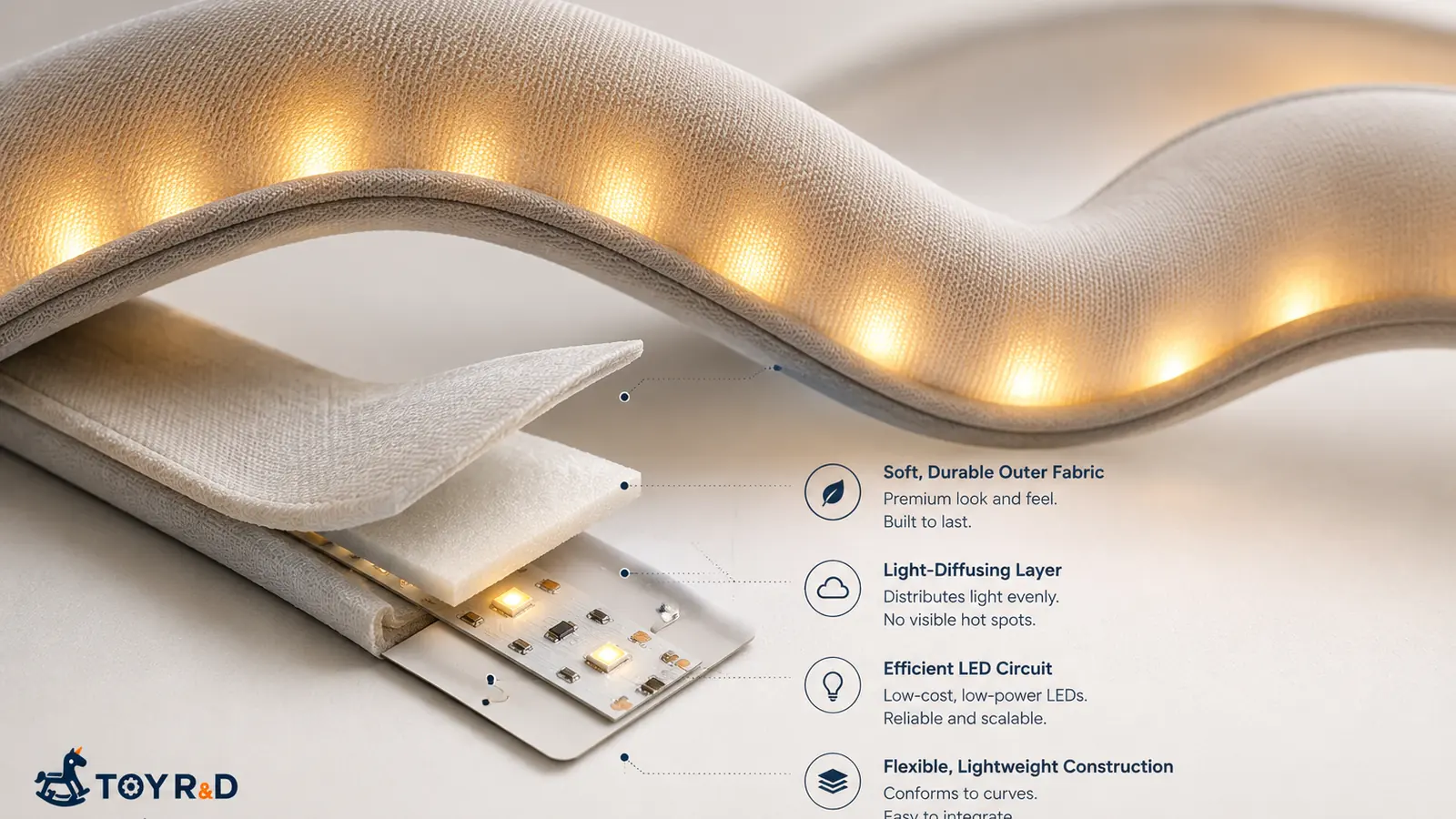
In one project, we needed to add a lighting effect inside a soft, flexible textile structure.
From an electronics perspective, this did not seem particularly complicated.
If a structure needs to bend while carrying multiple LEDs, one of the most obvious solutions is:
Use a flexible printed circuit, or FPC.
That is exactly what FPC is designed for.
It is thin, flexible, suitable for mounting LEDs, and technically easy for an electronics engineer to justify.
On paper, it looks like the standard answer.
But product development is different from pure electronics engineering.
A technically correct solution is not always the best product solution.
So we went back and looked at the actual requirements again.
Did the structure really need a full flexible circuit?
Did it need to survive repeated, extreme folding?
Did it require high-density routing?
High-speed signals?
Very tight dimensional tolerances?
Not really.
The real requirements were much simpler:
- It needed to carry LEDs.
- It needed to conduct electricity.
- It needed to tolerate a certain degree of bending with the textile structure.
- It needed to stay lightweight.
- It had to remain hidden inside the product.
- And it had to be inexpensive.
Once the requirements were broken down this way, the problem changed.
We were no longer asking:
“What is the best flexible circuit solution?”
We were asking:
“What is the lowest-cost structure that can reliably meet these actual requirements?”
Those two questions sound similar.
But they can lead to very different answers.
A Solution That Did Not Look “Premium”
The final solution was not a conventional high-spec flexible circuit.
Instead, we used a very low-cost circuit structure built on a substrate that naturally offered a useful degree of flexibility.
By itself, the material was not impressive.
It was not something a marketing team would put on the front of the package.
The end user would probably never know it existed.
But inside the right product structure, it did exactly what we needed.
The LEDs could be distributed along the flexible section.
The overall assembly could still bend sufficiently.
The electronics could remain hidden inside the textile construction.
And the user could still clearly perceive the intended lighting effect.
What the customer experienced looked more sophisticated than what the internal cost structure might suggest.
That is one of the most interesting things about product development.
The user experiences the result, not the BOM.
“Cheap” Does Not Mean “Bad”

There is an important distinction here.
Cost optimization is not simply about finding a cheaper component.
If you replace a two-dollar part with a one-dollar part but create more failures, more assembly difficulty, more rework, more compliance risk, or more after-sales problems, that is not real cost optimization.
Good cost engineering means:
Finding a lower-cost solution that still satisfies the performance the product genuinely requires.
In some cases, a simpler and cheaper structure may even be more suitable for mass production than a supposedly “better” solution.
That is why I do not find it particularly useful to divide materials into:
premium materials and low-end materials.
A better distinction is:
the right material and the wrong material.
Do Not Choose the Material First and Justify It Later
Engineers naturally tend to begin with the technologies they already know.
An electronics engineer sees a flexible structure and thinks of FPC.
A mechanical engineer sees a connection problem and thinks of screws, snap-fits, or reinforcement ribs.
A supplier sees an appearance issue and may immediately suggest painting, UV printing, IMD, or another added component.
None of these solutions are necessarily wrong.
The problem is that we sometimes move too quickly into how to build something before clearly defining what the product actually needs.
A useful habit in product development is to ask, before choosing the solution:
What conditions does this feature truly need to satisfy?
Then break those conditions down.
For example:
How much does it actually need to bend?
How many bending cycles does it need to survive?
Can the user touch this component?
What is the realistic product life requirement?
Is the feature carrying a functional load, or is it mainly creating a visual effect?
Is this level of performance genuinely required by the product, or was it added by the engineering team simply because it was possible?
A surprising amount of unnecessary cost enters a product before these questions have been properly answered.
Premium Products Do Not Always Come From Expensive Parts

I increasingly enjoy studying products that are clever on the outside and surprisingly simple on the inside.
They create strong perceived value without relying on excessive material cost.
In many ways, that is harder than simply using expensive components.
Because good product engineering is not:
“I know an advanced technology, so I should put it into the product.”
It is:
“I know many possible technologies, but I will only use the one this product actually needs.”
That is why opening a well-designed mass-produced product can sometimes create a strange reaction:
“That is all there is to it?”
But this kind of simplicity is rarely accidental.
It is often what remains after many rounds of trade-offs, simplification, testing, and decision-making.
A ToyRD Product Development Principle
At ToyRD, these are exactly the kinds of engineering decisions I want to keep documenting.
Not simply:
Which material is the best?
Which chip is the most advanced?
Which manufacturing process is the most sophisticated?
But rather:
What is the most reasonable choice when cost, performance, reliability, manufacturability, and user experience all have to be balanced at the same time?
Great products are not always great because they use expensive things.
Often, they are great because someone understood precisely:
where the money should be spent — and where it should not.
Sometimes, a very ordinary material, used in exactly the right place, can create a surprisingly extraordinary result.
That may be one of the most interesting parts of product development.
Have a question or a correction? Send feedback on this article.
Was this article helpful?
Your feedback helps improve these field notes.
No account needed. Your choice is remembered in this browser. Privacy policy
Leave a Reply
You must be logged in to post a comment.